
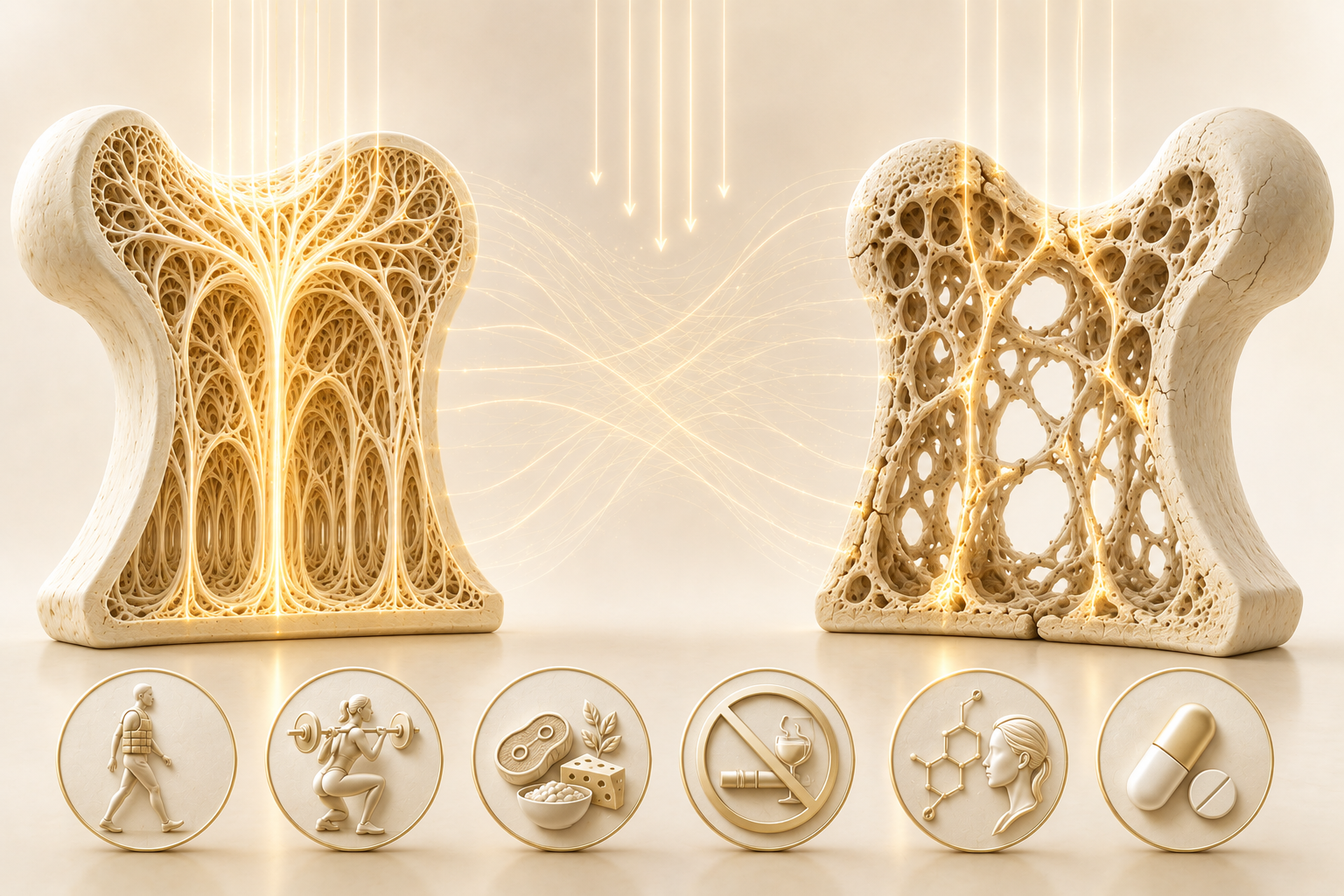
The Hard Part of Building Bone Isn't the Work
You could do all six of these perfectly. Lift heavy. Eat for the lattice and the minerals both. Fix the hormones. And still be guessing.
Because every one of them works. And not one of them works blind.
Bone loss doesn't happen at random, and it doesn't reverse by luck. It has a cause — usually more than one — and the six things below only move the needle when they're aimed at the cause that's actually yours. Aim them at the wrong one and you'll work hard for a year to fix a problem you never had.
Every one of them works. And not one of them works blind.
The Math Changes at 35
Bone is alive. Two crews work it around the clock — one laying down new material, one clearing the old. In your twenties, the builders win. You reach peak bone mass by your mid-twenties, and from there the balance is yours to protect or to lose.
After 35, without the right inputs, the breakdown crew starts winning. Quietly. You can't feel it. Most people learn their bones have been thinning for a decade on the day something breaks — and by then the easy window is already behind them.
There are six things that actually move that math, and none of them are new. The research has sat in the orthopedic and endocrinology literature for years. Here they are, in the order you can put them to work.
1. Load It Every Day You Can
Bone adapts to force — Wolff's Law, and it's held up since the 1800s. But there's a threshold. Harold Frost's mechanostat pinned it down: below a certain level of strain, bone is quietly lost; only above it does the skeleton switch on new bone. Astronauts lose 1–2% of bone mass a month in zero gravity — the same rapid loss Echolight's technology has been used, alongside NASA, to study. A desk chair runs a slower version of the same program. Walking and standing hold most of what you have. They rarely cross the line that builds — which points straight at the next one.
2. Lift Heavy — Really Lift
"Weight-bearing exercise" is too vague to change a skeleton. The training that actually raised bone density in the trials was heavy, progressive resistance and impact — squats, hinges, presses, pulls, loaded hard enough to matter. Muscle pulls on bone; bone answers by getting denser. Light weights and long walks are good for you, but they are not the stimulus your skeleton is waiting for. Get coached on form before you go heavy — the cost of doing it wrong is a real injury.
3. Eat for the Scaffold and the Mineral
Bone is a protein lattice with mineral hung on it. Skimp on protein and there's nothing to build on; skimp on calcium and vitamin D and there's nothing to hang. And eating isn't the same as absorbing — stomach acid, a healthy gut, and the fat-soluble vitamins are what actually move those minerals into bone, which is why a flawless diet can still come up short. The literature points to roughly 1,000–1,500 mg of calcium a day (food first), 800–1,000 IU of vitamin D taken with a little fat, and more protein than the old guidelines assumed. Confirm your own targets with a clinician before you stack supplements — more isn't better, right is better.
4. Stop Feeding the Breakdown
Alcohol lowers the hormones bone depends on. Smoking drives the inflammation that tells the breakdown crew to keep going — the same oxidative stress that quietly suppresses your bone-builders. These are among the most modifiable levers you have, and the fastest to act on.
5. Take the Hormones Seriously
In the first years after menopause, bone loss accelerates sharply — estrogen is the reason. In men, low testosterone does the same quiet downstream work. This is a real conversation to have with a physician who reads the current evidence, not a decade-old headline.
6. Weigh Medication When It's Indicated
For someone with genuinely low density and a fracture already on the record, the risk-benefit math often favors treatment. For someone at the early edge of loss, the first five levers usually come first. Which one you are is not a guess — it's a measurement.
Read That List Again. Every One Needs the Same Thing First.
Notice what all six have in common. Every one needs a starting point to be worth anything.
Without a baseline, you don't know which lever is urgent for you. You don't know whether the problem is how much mineral you have or how well it's organized — density and quality are two different things, and research suggests more than half of fragility fractures happen in people whose density scores sit above the osteoporosis line. A "normal" number is not the same as a safe one.
The default in this country is to wait. Wait until 65. Wait for a fracture. Then hand you a single number from a single test that compares you to a reference population that isn't you.
See the Whole Picture. Once.
That's what a REMS assessment is for. It measures bone density and bone quality and gives you a direct 5-year fracture risk score — three answers, not one number. It runs on ultrasound, so there's no radiation, which means you can start young and repeat it as often as it's useful. About 45 minutes. No hospital. No referral. Results explained to you in the room, the same day.
The same REMS technology is being used in an EU-funded, peer-reviewed multicenter trial — the first of its kind to assess bone health from fetal life through adulthood. Washington State has only two REMS providers. We're the only mobile one — based in Port Orchard, and we bring the scan to you across Western Washington.
Start With the Number That Tells You Where to Aim
Do the six. Move your body, load it hard, eat for both the scaffold and the mineral, cut what tears bone down, take the hormones seriously, weigh medication when it's indicated. All of it works.
But see your bones first. A baseline at 35 is one no scan at 60 can give you — the trajectory is set in the window nobody measures. Not a guess. The whole picture, once, so every choice you make for the next thirty years is aimed at the skeleton you actually have.
$250, radiation-free, about 45 minutes, and we come to you anywhere in Western Washington.
This article is for educational purposes only and is not medical advice, diagnosis, or treatment. A REMS scan provides bone-health information; consult your healthcare provider for medical guidance.