
If you have ever been told to "get a bone density scan," you have probably pictured a DEXA machine in a hospital radiology department. For decades that has been the standard. There is now another option that is radiation-free, portable, and tells you more than density alone: a REMS scan.
What REMS actually is
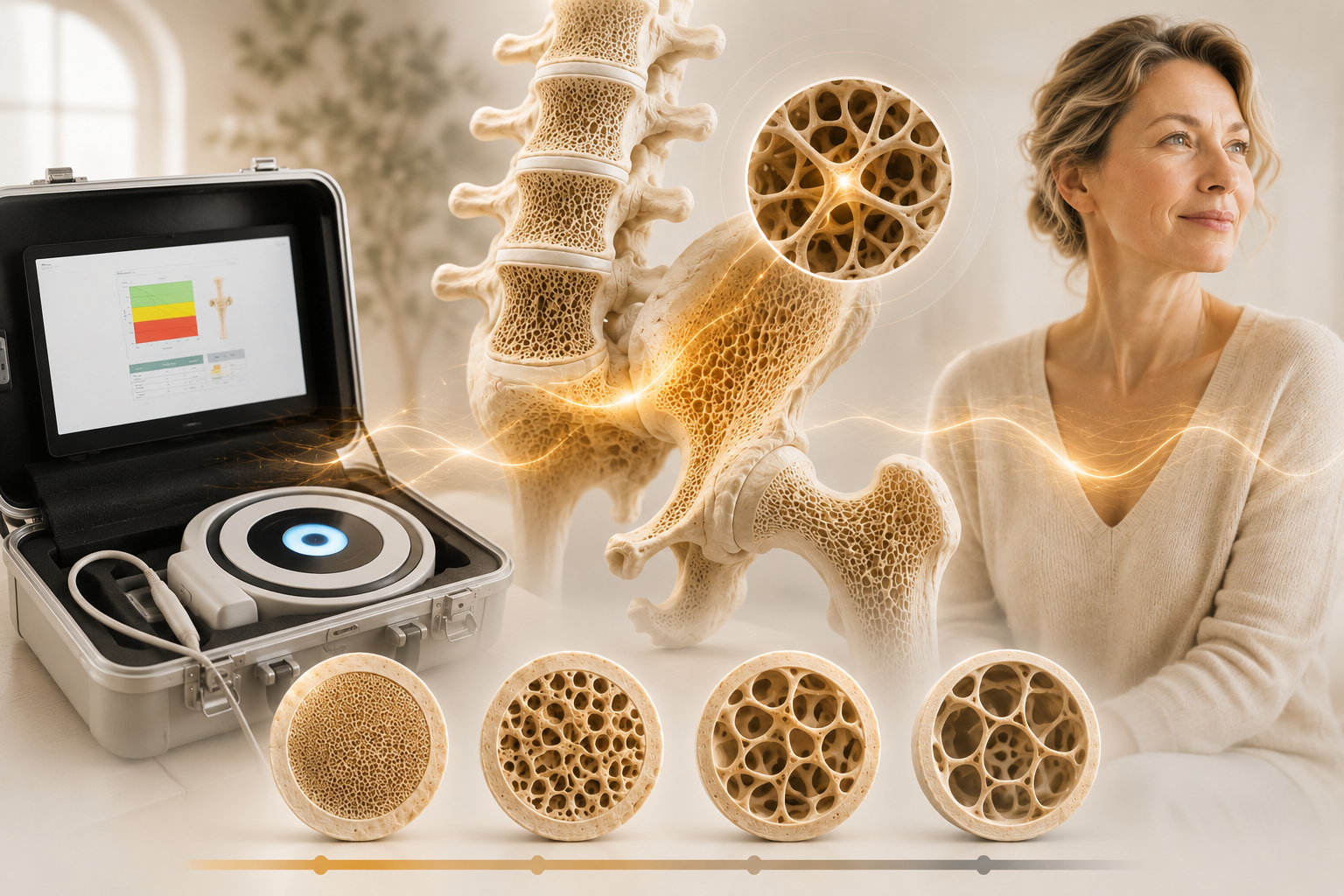
REMS stands for Radiofrequency Echographic Multi Spectrometry. It is an ultrasound-based technology that reads the bone in your lower spine and hip. Because it uses sound waves rather than X-rays, there is no radiation involved, and the scan can be repeated as often as your situation calls for.
A REMS scan looks at four things:
- Bone density — how much mineral your bones hold.
- Bone quality — the architecture and integrity of the bone, not just its mass.
- 5-year fracture risk — a forward-looking estimate, not only a snapshot of today.
- Body composition — a fuller picture of what is going on alongside your bone health.
REMS and DEXA, side by side
A DEXA scan uses a small dose of X-ray radiation and is fixed in a clinic or hospital. It reports bone density, which is useful but is only part of the story. Two people can share the same density number and have very different bone strength, because the structure of the bone matters too.
REMS is different in three practical ways. There is no radiation, so it is safe to repeat and safe during pregnancy. It adds bone quality and a fracture-risk estimate on top of density. And because the equipment is portable, the scan can come to you instead of the other way around.
Why radiation-free matters
Bone health is something you watch over time, not once. When a scan carries no radiation, there is no reason to ration how often you check in. That makes REMS well suited to tracking change, whether you are following the effect of a treatment, a change in diet, or a new exercise routine.
Who tends to ask about it
People who think about REMS are usually keeping an eye on their bones for a reason: women moving through perimenopause and beyond, anyone with a family history of fractures, and people who simply want a baseline so future changes are easy to spot.
What a scan is like
The appointment takes about 45 minutes. You lie comfortably face-up while a small probe moves over your lower spine and hip. There is no injection and no compression, and you walk away the same day with results explained to you, followed by a full report by email. You can read more about what to expect before you book.
One important note: a REMS scan assesses your bone health. It does not diagnose or treat disease. What it gives you is clear information to take to your own practitioner.
If you would like that information, you can book a complimentary appointment across Western Washington, and we will come to you.