
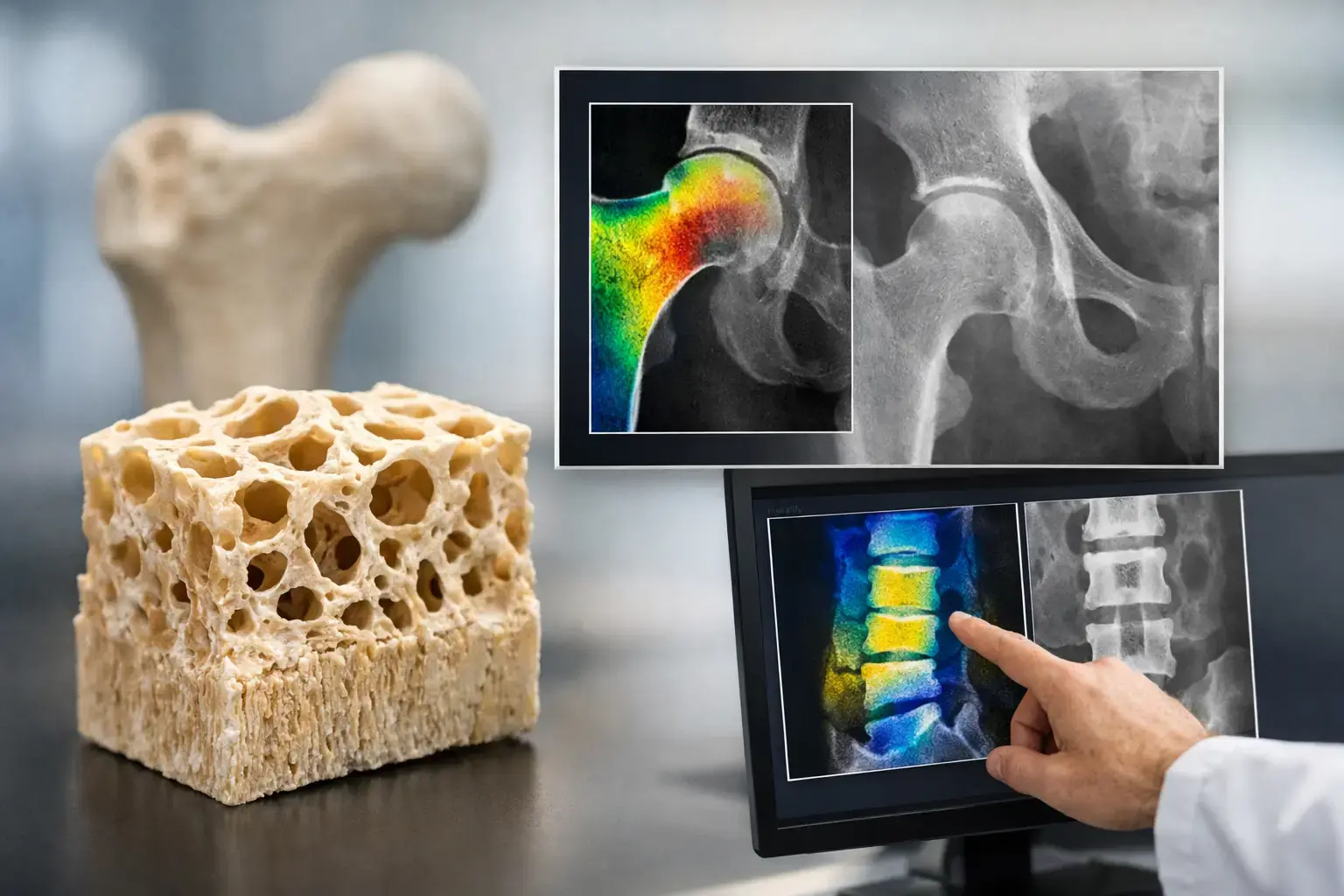
A bone density result can feel definitive, especially if you have been told your T-score is normal or only mildly low. But bone quality versus density is the question behind an uncomfortable clinical reality: two people can have similar bone mineral density and meaningfully different risks of fracture.
Density remains useful. It measures how much mineralized bone is present, and it has been central to osteoporosis assessment for good reason. But a density number alone cannot fully describe whether bone is showing the signal patterns associated with greater fragility. That distinction matters before a fracture is the event that makes bone health visible.
Density measures amount, not the whole fragility picture
Bone mineral density, or BMD, is an estimate of the mineral content in a defined area of bone. Results are commonly expressed as a T-score, which compares your density with the average density of a healthy young adult reference population. Lower scores are associated with higher fracture risk, and established diagnostic thresholds for osteoporosis are based on BMD.
That makes density an essential part of the picture. It does not make it the entire picture.
Fracture risk reflects more than mineral quantity. Age, prior fractures, falls, certain medications, medical conditions, and the characteristics of the bone tissue itself all contribute. A density test can show that two people have a similar amount of mineralized bone at the spine or hip. It cannot, by itself, tell us whether the ultrasound signals from those bones show the same signs of fragility.
Think of two people whose density reports look nearly identical. One may have a lower fragility signal and a lower estimated near-term fracture risk. The other may have a higher Fragility Score, meaning the reflected ultrasound signals contain more features associated with skeletal fragility. Their density is similar. Their overall bone information is not.
What “bone quality” means, and why the term needs care
“Bone quality” is often used as a catch-all phrase for the features that influence bone strength beyond mineral density. In research and clinical conversation, it can refer broadly to bone structure, tissue composition, turnover, accumulated damage, and other properties that affect how bone behaves under load.
That broad definition is useful, but it can also become misleading when it suggests that one test directly measures every feature of bone quality. It does not.
REMS does not measure flexibility, failure load, or every aspect of bone microarchitecture. What it does is more specific: it measures bone mineral density at the lumbar spine and proximal femur using radiation-free ultrasound, then analyzes the raw ultrasound signals reflected from bone to derive an independent Fragility Score. The score captures signal characteristics associated with fragility that density alone does not capture.
This is why bone quality versus density is not an either-or argument. Density answers a necessary question: how much mineralized bone is present? The Fragility Score adds another: is the bone showing more or fewer ultrasound signal features associated with fragility? Together, these measures can be used to estimate five-year fracture risk.
The false-normal problem in type 2 diabetes
Type 2 diabetes is one of the clearest examples of why a density result can be reassuring without being fully reassuring.
People with type 2 diabetes often have bone mineral density that is normal or even higher than expected, yet studies consistently show elevated fracture risk compared with people without diabetes. The reason is not that density has become meaningless. Rather, density does not account for every diabetes-related change that may affect skeletal fragility.
Chronic high blood glucose can contribute to the formation of advanced glycation end products in collagen, the protein framework within bone. Bone is not simply a block of mineral. Its mineral and collagen components work together. Changes to collagen cross-linking are one proposed mechanism for why fracture risk may rise even when BMD does not look low. Diabetes-related neuropathy, vision changes, and fall risk can add further complexity.
For someone with type 2 diabetes, a normal density score should not automatically end the bone-health conversation. It may be a good result, but it is not the same as a complete fracture-risk assessment.
When density and fragility information may tell different stories
The gap between density and fragility information is not limited to diabetes. It can matter when bone changes quickly or when risk is influenced by factors BMD does not fully reflect.
During perimenopause and menopause, declining estrogen can accelerate bone loss. Yet routine screening often begins years after this transition for people without a clear risk factor. A baseline can establish where your density stands, while repeated measurement can show whether a meaningful change is occurring over time.
The question can also arise after long-term glucocorticoid exposure, cancer treatment histories, substantial weight loss, or during treatment with medications that affect weight and metabolism. These situations do not all carry the same type or level of risk, and a scan does not replace the clinical context your physician considers. They do illustrate why one number rarely tells the whole story.
For people already diagnosed with osteopenia or osteoporosis, additional information can be clarifying rather than alarming. A T-score identifies a density category. It does not necessarily answer whether the ultrasound-derived fragility information points in the same direction, or how the combined information translates into estimated fracture risk over the next five years.
What REMS adds to a bone assessment
REMS, or Radiofrequency Echographic Multi Spectrometry, uses ultrasound rather than ionizing radiation. It assesses BMD at the lumbar spine and proximal femur, the same clinically important sites often assessed in bone-density testing. Its distinguishing feature is the analysis of raw radiofrequency ultrasound signals to generate the Fragility Score in addition to BMD.
A REMS report provides three pieces of information that can be followed over time: bone mineral density, an independent Fragility Score, and an estimated five-year fracture risk derived from the two together. Each addresses a different part of the question.
Density describes mineralized bone amount. The Fragility Score describes reflected-signal features associated with fragility. The risk estimate puts those measurements into a more practical frame: what might they mean together for fracture risk in the years ahead?
That does not make a risk estimate a prediction of your future. No scan can say with certainty whether a particular person will fracture. Falls, health changes, medications, and other events remain relevant. A risk estimate is a way to turn measurements into a clearer discussion with your physician, not a substitute for that discussion.
Precision matters when you want to track change
Bone health changes slowly in many circumstances, but not always. Menopause, illness, medication exposure, and rapid body-weight changes can alter the pace. If you are measuring a small biological change, the instrument’s precision matters because every test has some degree of measurement variation.
MobileREMS uses FDA-cleared REMS technology with an intra-operator precision error below 0.5%. For context, commonly reported DXA precision error at the spine is approximately 0.9% to 1.9%. Lower measurement error is not merely a technical detail. It can make it more feasible to re-measure over months rather than waiting years, with greater confidence that a change in the report reflects a change in bone rather than ordinary measurement noise.
Precision does not eliminate the need for consistent technique, appropriate interpretation, or clinical context. It does create a more useful opportunity to observe trends, particularly for people who want objective information before a fracture or a major treatment decision forces the issue.
A more complete question to bring to your bones
The most useful bone-health question is rarely, “Is my density normal?” A more complete question is: “What does my density show, is there independent evidence of greater fragility, and what do those findings mean together?”
That framing leaves room for good news without false reassurance and for concern without panic. It recognizes that bones are living tissue, changing gradually and often silently. Having clearer information about them gives you something better than guesswork: a starting point for an informed conversation, long before consequences have to start it.