
A patient with type 2 diabetes can receive a bone density result that looks normal, sometimes even reassuringly high, while their fracture risk remains elevated. That gap is one reason mobile bone density testing for clinics deserves a closer look. A density number measures how much mineralized bone is present. It does not, by itself, fully describe whether the bone is showing signal patterns associated with greater fragility.
For a clinic, the question is not simply whether a mobile service can place a scanner in the office. It is whether the assessment adds clinically useful information, fits the patient experience, and creates a report that supports a more informed conversation about skeletal health. Radiation-free REMS technology is designed around that broader question.
What mobile bone density testing can add to a clinic
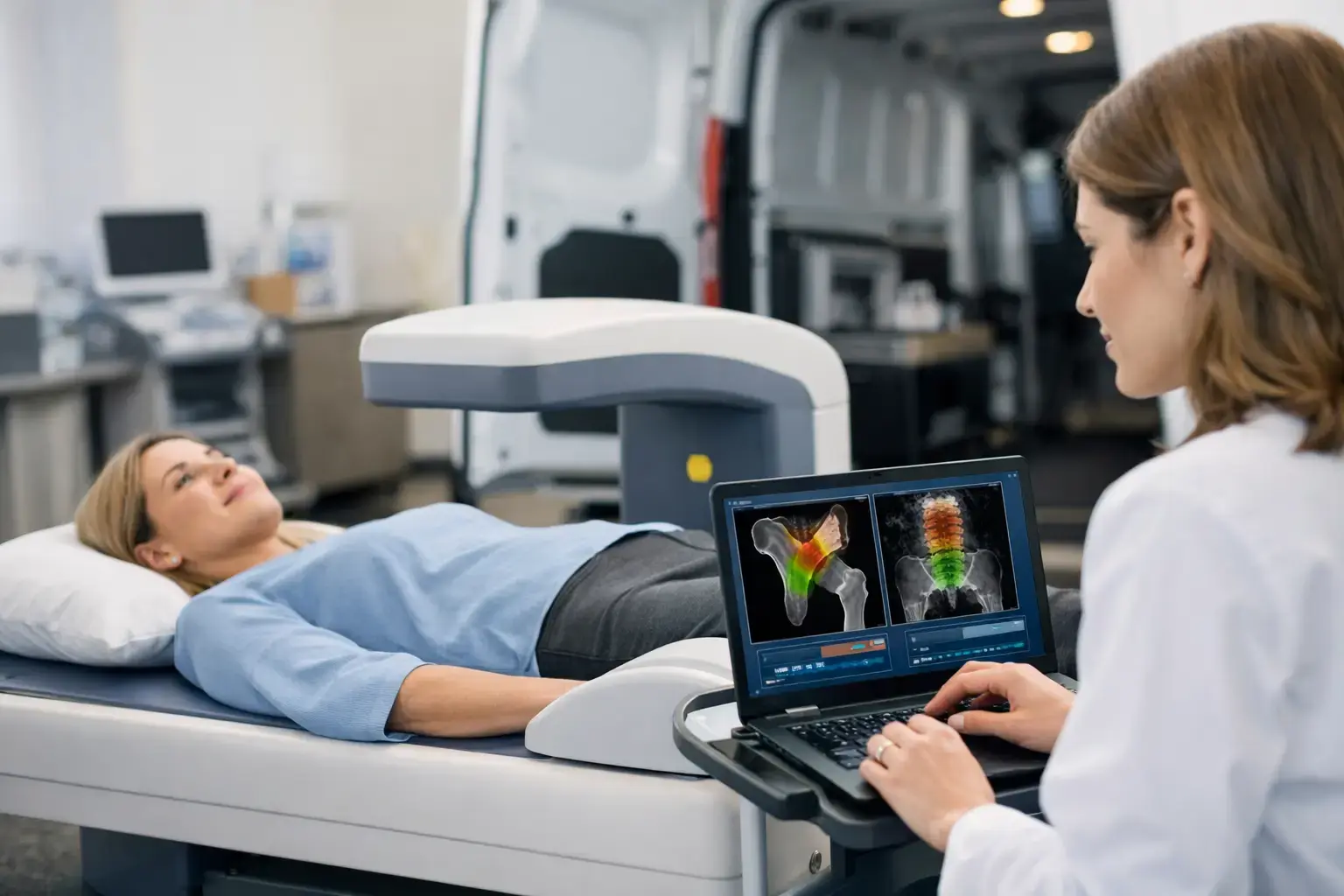
Mobile assessment brings a trained operator and a portable REMS system to the practice or organization. The scan measures bone mineral density at two clinically important sites: the lumbar spine and proximal femur. Those measurements produce familiar density outputs, including T-scores and Z-scores where applicable.
But REMS, or radiofrequency echographic multi-spectrometry, does more with the ultrasound data. It analyzes raw ultrasound signals reflected from bone to derive an independent Fragility Score. The score reflects signs associated with skeletal fragility that density alone does not capture. REMS then weighs density and the Fragility Score together to estimate five-year fracture risk.
That distinction matters because a patient can have a density result that does not tell the complete story. Think of two people with similar bone mineral density at the hip. Their density values may place them in the same category, yet their reflected ultrasound signals can differ. If one has a higher Fragility Score, the combined information may point to a different estimated fracture risk over the next five years.
The purpose is not to replace clinical judgment or reduce a person to three numbers. It is to make a part of bone health that is usually invisible more visible: how much mineralized bone is present, whether the signal is associated with greater fragility, and what those findings mean together for estimated fracture risk.
Why density alone can miss relevant risk
Bone mineral density remains useful. It is well established in osteoporosis assessment, and it gives clinicians a measurable baseline for bone quantity. The limitation is conceptual, not a reason to dismiss density. Fractures are not determined by mineral quantity alone.
Type 2 diabetes is the clearest example of why this distinction deserves attention. Research has repeatedly shown a paradox: people with type 2 diabetes may have normal or higher bone mineral density while experiencing higher fracture risk. The mechanisms are still being investigated, but altered bone material properties, accumulation of advanced glycation end products, falls risk, and other metabolic factors may contribute. A normal density result should not be assumed to settle the fragility question in this population.
Similar uncertainty can arise with long-term glucocorticoid exposure, cancer-treatment histories, rapid weight loss, and other circumstances that affect bone metabolism or fracture risk. The degree of risk, and the relevance of any one factor, depends on the individual clinical picture. A mobile assessment does not diagnose the cause of risk. It can provide objective bone information for the clinician and patient to interpret in context.
For patients with osteopenia or osteoporosis, this can also change the quality of the follow-up conversation. They may already know their T-score. What they often want to understand is whether the signal-based Fragility Score tells the same story as density, and whether future measurements show a meaningful change rather than ordinary measurement variation.
The role of precision in monitoring
Precision is not an abstract specification when a clinic is deciding how to follow change over time. Every measurement system has some degree of variation. If that variation is too large, small changes on a report may be difficult to distinguish from measurement noise.
REMS is FDA-cleared, uses no ionizing radiation, and has reported intra-operator precision error below 0.5%. That is measurably tighter than the approximately 0.9% to 1.9% precision error often reported for DXA at the spine. Precision can support repeat assessment over shorter intervals when clinically appropriate, because a reported change has a stronger chance of reflecting a real biological change rather than variation in the test itself.
This does not mean every patient needs frequent scanning, nor does it establish what monitoring schedule is right for a given person. It means the technology can make closer observation possible when the clinical situation calls for it. That is particularly relevant when bone health may be changing faster than usual, such as around menopause, during significant weight change, or while evaluating the effects of a broader care plan.
How the mobile model fits clinic operations
The operational appeal of mobile bone density testing for clinics is straightforward: patients can access objective skeletal data in a familiar care setting without the clinic purchasing, housing, and staffing a fixed imaging system. The scan is radiation-free and does not require the infrastructure associated with X-ray-based testing.
The more meaningful benefit is continuity. A concierge physician, nurse practitioner, naturopathic provider, or functional-medicine practice may already be tracking metabolic health, body composition, hormones, medication history, and lifestyle factors. Bone information can be brought into that same conversation rather than treated as a disconnected referral item.
A useful mobile program should still have clear boundaries. REMS results are information for clinical assessment, not a substitute for a patient history, fracture history, medication review, laboratory evaluation, or physician judgment. A report should be understandable enough for the patient to keep and detailed enough for the referring clinician to use. It should also state what the technology measures rather than implying that it directly measures bone strength, microarchitecture, flexibility, or failure load.
For organizations hosting a bone-health event, the same principle applies. Access can be valuable, but the experience should not turn screening into a fear-based exercise. People need clear information about what a result can show, what it cannot answer on its own, and how to bring the findings into their usual medical care.
Which patients may find the added information meaningful
A clinic does not need to limit bone conversations to people who already carry an osteoporosis diagnosis. Perimenopause and menopause are important transitions because bone loss can accelerate while routine population screening may still be years away. An earlier baseline can help make future changes interpretable.
Prevention-focused patients are another overlooked group. Many track lipid markers, glucose, fitness performance, body composition, and cardiovascular risk, yet know little about their skeletal baseline. Peak bone mass is largely established by early adulthood, genetics influences much of that ceiling, and bone loss may begin from midlife onward. A person can be highly engaged in health data and still have no clear picture of their bones.
Patients making decisions may also benefit from more complete information: someone considering osteoporosis medication, preparing for an orthopedic procedure, or monitoring health during rapid weight change may want data to discuss with their care team. The scan cannot make those decisions for them. It can give the conversation a firmer factual starting point.
Choosing a mobile REMS partner
The technology matters, but so does the quality of the service around it. Clinics should look for trained operators, consistent acquisition procedures, clear reporting, and a process for sharing results with both the patient and their clinician. The point of a mobile service is not merely convenience. It is reliable information delivered in a format that can be acted on through appropriate clinical care.
MobileREMS brings Echolight REMS technology to partner practices and organizations in the Seattle area and Phoenix area, with the goal of making this kind of information more accessible before a fracture forces the conversation.
A good bone assessment does not promise certainty. It gives you and your patients a clearer view of what density says, what it leaves unanswered, and where a fuller discussion of fragility and fracture risk may begin.