
Your menstrual cycle may be changing before anyone has mentioned your bones. That is the gap this perimenopause bone health guide is meant to address: bone loss can accelerate during the menopause transition, while routine osteoporosis screening often begins years later.
This is not a reason for alarm. It is a reason to understand the biology while there is still time to establish a clearer baseline. Bones are living tissue, continually being broken down and rebuilt. Perimenopause changes the hormonal environment that helps regulate that process, sometimes quickly and quietly.
Why perimenopause changes bone remodeling
Estrogen does more than regulate the menstrual cycle. In bone, it helps restrain osteoclasts, the cells responsible for breaking down old bone tissue. It also supports the balance between bone breakdown and the work of osteoblasts, the cells that form new bone.
As ovarian hormone production becomes more variable in perimenopause, estrogen can rise and fall unpredictably before settling at lower postmenopausal levels. Those fluctuations affect bone remodeling. More bone may be resorbed than replaced, particularly in the years around the final menstrual period.
The pace is not identical for everyone. Genetics influences the amount of bone you built earlier in life, often called peak bone mass. Body weight, nutrition, physical activity, smoking, alcohol exposure, certain medications, thyroid conditions, inflammatory disease, and family history can all shape the picture. A person with no obvious risk factors can still experience meaningful change through this transition.
The key point is simple: menopause-related bone loss is often silent. You do not feel bone remodeling. A fracture is frequently the first event that makes the issue visible, which is far later than most people would choose to learn about it.
Density matters, but it is not the whole question
Bone mineral density, commonly reported as a T-score on a DXA scan, measures how much mineralized bone is present. It remains a valuable clinical measure and an established part of osteoporosis assessment. Lower density is associated with higher fracture risk.
But density is not a complete description of skeletal fragility.
Picture two people with similar bone density at the hip. On paper, their density result may look nearly the same. Yet one person’s bone may show more signal patterns associated with fragility than the other’s. Their fracture risk may not be the same, even though a density number alone cannot distinguish them.
That distinction matters in perimenopause because this is often a period of change rather than a fixed diagnosis. A single density value can establish where you are. It cannot, by itself, answer every question about whether the bone is showing signs associated with greater fragility or how density and fragility combine into near-term fracture risk.
A normal density result is useful information. It is not a lifetime guarantee, and it does not always close the conversation. This is especially relevant when other risk factors are present, such as a parental hip fracture, long-term glucocorticoid use, early menopause, low body weight, malabsorption conditions, or a history of treatment that affects hormone production.
A perimenopause bone health guide to the information gap
The practical question is not whether bone density matters. It does. The more useful question is what information you need at this stage of life to understand your bones before consequences force the conversation.
A conventional density measurement can help identify low bone mass and osteoporosis, track a known condition, and support clinical decision-making. Depending on your age, medical history, and risk factors, a clinician may use it alongside other information to estimate fracture probability.
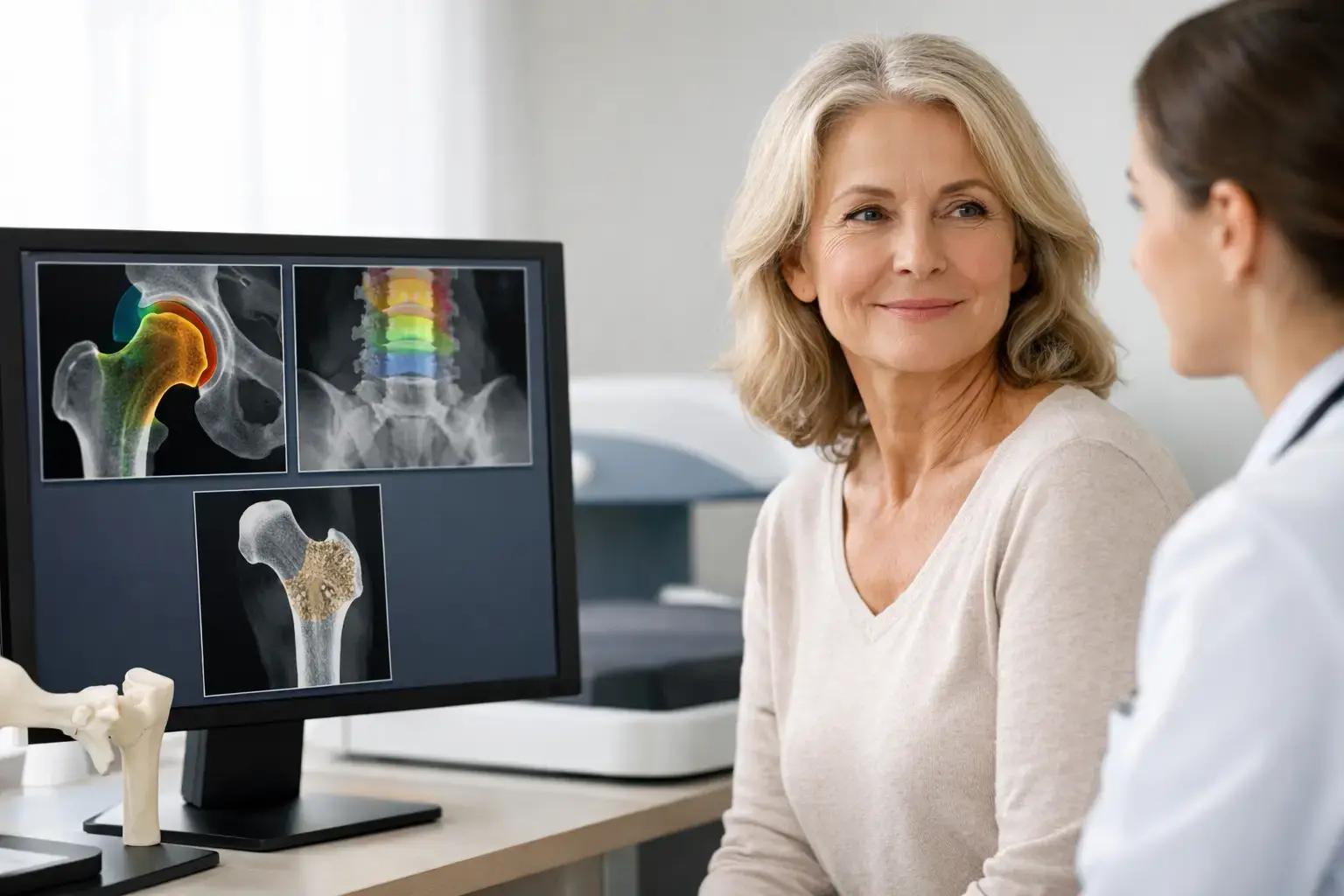
REMS, or Radiofrequency Echographic Multi Spectrometry, adds another layer of information. This radiation-free ultrasound technology measures bone mineral density at the lumbar spine and proximal femur, the same major skeletal sites central to fracture assessment. It also analyzes raw ultrasound signals reflected from bone to derive an independent Fragility Score.
The Fragility Score reflects signs associated with skeletal fragility that density alone does not capture. It is not a replacement term for density, and it does not claim to directly measure every property that determines whether a bone fractures. Rather, it provides distinct information from the reflected ultrasound signal. REMS then considers density and Fragility Score together to estimate five-year fracture risk.
That produces three understandable pieces of information: how much mineralized bone is present, whether the signal shows signs associated with greater fragility, and what those measures together suggest about near-term fracture risk.
For someone in perimenopause, this can change the nature of the conversation. Instead of waiting to see whether a later screening result crosses a diagnostic threshold, you can have objective data that helps establish a baseline and makes future change easier to interpret.
What a baseline can and cannot tell you
A baseline scan is a starting point, not a prediction written in stone. It does not tell you exactly what will happen to your bones over the next decade. Fracture risk is influenced by age, falls, medications, health conditions, prior fractures, muscle strength, and many other factors beyond any one test.
What a baseline can do is replace assumptions with measurements. If you have never assessed your bones, you may not know whether you entered perimenopause with above-average density, low-normal density, or a lower reserve than you expected. You also may not know whether density and fragility are telling a consistent story.
This matters for people who already pay close attention to health data. Many adults track glucose, lipids, blood pressure, fitness, sleep, and body composition. Bones are often left out because their changes are less visible. Yet peak bone mass is largely built by early adulthood, and decline can begin well before the age at which many people first receive routine screening.
The value of earlier information is not that every result will reveal a problem. Many will be reassuring. The value is that reassurance can be specific, and an unexpected finding can be discussed with a physician while choices are still broad.
The broader context: lifestyle, medications, and medical history
Bone responds to its environment. Mechanical loading stimulates bone adaptation, which is one reason movement and muscle forces matter to skeletal health. Adequate protein, calcium, and vitamin D support the biological processes involved in bone metabolism, although individual needs and laboratory interpretation belong in a clinical conversation.
Certain circumstances deserve particular attention during the menopause transition. Long-term glucocorticoids can affect bone remodeling. Some breast cancer treatments, ovarian suppression, and other therapies that reduce estrogen exposure may accelerate bone loss. Bariatric procedures and gastrointestinal conditions can alter nutrient absorption. Rapid weight loss may also be relevant because body weight, muscle, nutrition, and bone metabolism are interconnected.
Type 2 diabetes is another important example of why density is not the entire story. Research has repeatedly shown that people with type 2 diabetes can have normal or even higher bone mineral density while experiencing elevated fracture risk. Changes in bone material quality related to chronic hyperglycemia are one proposed mechanism. A reassuring density result in that setting may be incomplete rather than wrong.
None of these factors means a fracture is inevitable. They mean that context changes how a result is interpreted. A good bone-health conversation brings together measurements, medical history, medications, and the factors that affect falls and fracture risk.
Why measurement precision matters during change
When bone is changing gradually, small differences between scans can be difficult to interpret. Every measurement method has some degree of variation. The question is whether an apparent change reflects a real biological shift or ordinary measurement noise.
REMS is FDA-cleared and radiation-free, with reported intra-operator precision error below 0.5%. That level of precision matters because it can make repeat measurements more informative over shorter intervals than methods with larger measurement error. It does not eliminate the need for clinical judgment, but it strengthens the value of following a trend.
MobileREMS uses this approach to provide density, an independent Fragility Score, and an estimated five-year fracture risk in a report that can be shared with your physician. The purpose is not to label every midlife change as disease. It is to make a normally invisible process more understandable.
Perimenopause asks a great deal of the body, often before it announces itself clearly. Knowing more about your bones during that transition does not require fear or a diagnosis. It can simply be part of treating bone health like the long-term health measure it is: something worth understanding before a fracture has to explain it for you.