
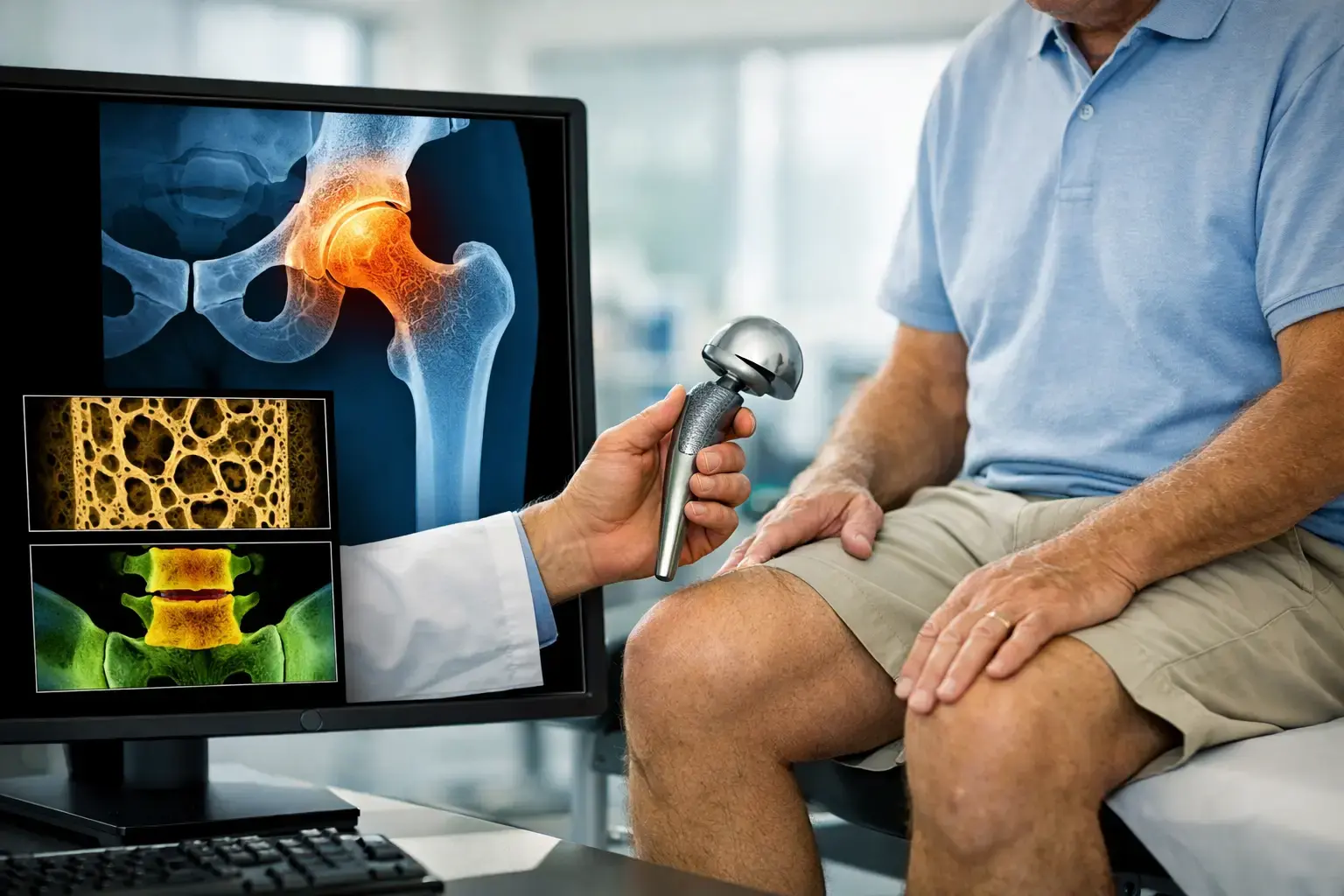
A hip or knee replacement is often discussed in terms of pain, mobility, implant choice, and recovery time. But bone health before joint replacement belongs in that conversation too. The implant does not exist separately from your skeleton: its fixation, alignment, and long-term support depend in part on the bone around it.
That does not mean poor bone health automatically rules out surgery, or that a bone scan predicts a surgical outcome on its own. It means your surgical team may need a clearer picture of the bone they are working with - especially if you have osteoporosis, a prior fragility fracture, type 2 diabetes, long-term glucocorticoid exposure, rapid weight loss, or other reasons bone strength may not be fully reflected by a routine density result.
Why bone quality enters the joint-replacement conversation
Joint replacement replaces damaged joint surfaces, not the entire load-bearing system around them. In a hip replacement, the femur and pelvis support components that must remain stable under repeated force. In a knee replacement, the femur and tibia provide the foundation beneath the implant. Bone is living tissue, constantly remodeling in response to mechanical forces, hormones, nutrition, illness, and medications.
Surgeons assess many factors before an operation, including imaging of the joint, anatomy, alignment, medical history, and the condition of surrounding tissue. Bone status may affect the conversation about fixation technique, implant selection, timing, and how closely bone health is followed after surgery. The details depend on the joint being replaced, the reason for surgery, and the individual clinical picture.
The concern is not limited to a diagnosis labeled osteoporosis. Lower bone strength can be associated with complications such as fracture around an implant, called a periprosthetic fracture, and may influence how securely an implant integrates with surrounding bone. These are clinical risks to assess, not conclusions to draw from one number.
A useful distinction is this: joint replacement addresses a damaged joint. Bone assessment helps clarify the condition of the framework carrying that new joint.
Density is useful, but it is not the whole question
Bone mineral density, commonly expressed as a T-score, estimates how much mineralized bone is present. It remains a central measurement in osteoporosis assessment. Lower density is associated with higher fracture risk, and density can help identify people who may benefit from further clinical evaluation.
But density is not a direct measure of every feature associated with skeletal fragility. Two people can have similar bone mineral density at the hip and still have different fracture risk. Their histories may differ. One may have had a low-trauma fracture, long-term steroid exposure, or diabetes. Their bone tissue may also show different signal characteristics associated with fragility.
Type 2 diabetes makes the density gap particularly visible. People with type 2 diabetes may have bone mineral density that appears normal or even higher than expected, while their fracture risk remains elevated. Several mechanisms may contribute, including changes in bone turnover and the accumulation of advanced glycation end products within bone collagen. The point is not that density is wrong. It is that a reassuring density result can be incomplete when other biology is changing the risk picture.
Before an orthopedic procedure, that distinction matters. A density number answers, “How much mineralized bone is present?” It does not independently answer, “Is this bone showing ultrasound signal patterns associated with greater fragility?”
What a more complete bone-health assessment can add
REMS, or Radiofrequency Echographic Multi Spectrometry, uses radiation-free ultrasound to measure bone mineral density at the lumbar spine and proximal femur. It also analyzes the raw ultrasound signals reflected from bone to produce an independent Fragility Score.
The Fragility Score is not another version of density. It reflects signal characteristics associated with skeletal fragility that bone mineral density alone does not capture. REMS then weighs density and the Fragility Score together to estimate five-year fracture risk.
That creates a more useful three-part conversation before joint replacement:
- How much mineralized bone is present?
- Is the bone showing signs associated with greater fragility?
- Taken together, what is the estimated fracture risk over the next five years?
Consider two people preparing for the same procedure. Both may have a bone density result in a similar range. If one has a higher Fragility Score and a higher estimated fracture risk, the similarity in density no longer tells the whole story. That information does not dictate a surgical plan. It gives the patient and clinical team a more informed starting point for discussing bone-related risk.
When timing matters before surgery
The best time to learn about bone health is usually before a fracture forces the issue. The same principle can apply before elective joint replacement, when there is time for information to be reviewed in the context of a broader plan.
This is especially relevant if you already know there may be a bone-health question. Perhaps you have osteopenia or osteoporosis on your record. Perhaps menopause coincided with accelerated bone loss, or you have been taking glucocorticoids. Perhaps a parent had a hip fracture, you have had a prior low-trauma fracture, or type 2 diabetes has made a normal density result feel less conclusive.
It can also be relevant when rapid weight loss, cancer treatment history, inflammatory disease, or reduced mobility has changed the context. None of these facts establishes your individual risk by itself. They are reasons a clinician may look beyond a single density value when considering the health of the skeleton.
A preoperative assessment is not a substitute for the surgeon’s own imaging and examination. Nor is it a guarantee against surgical complications. It is objective information that can be shared with the orthopedic team and the clinicians who manage your bone health.
Why precision matters if bone status is being followed
Bone changes slowly under ordinary circumstances, but some periods of life and treatment can alter bone more quickly. A measurement is most useful when it can distinguish a meaningful change from ordinary measurement variation.
REMS is FDA-cleared and radiation-free, with reported intra-operator precision error below 0.5%. That compares with the 0.9% to 1.9% precision error commonly reported for DXA at the spine. Precision does not make one scan a crystal ball. It means repeat measurements can be interpreted with greater confidence when tracking change over time.
For someone approaching surgery, this can matter if bone assessment is part of an ongoing clinical discussion rather than a one-time administrative checkbox. A report containing density, Fragility Score, and estimated five-year fracture risk gives you specific information to bring to your physician or surgical team.
Questions worth bringing to your care team
You do not need to arrive at an orthopedic appointment with a diagnosis already formed. A few clear questions can help make bone health visible in the planning process. Ask whether your history or current medications raise a bone-health concern, whether a prior density test is current and sufficient for your situation, and whether there is reason to assess fracture risk beyond density alone.
If you have a bone report, ask how its findings fit with the procedure being considered. The relevant answer may differ for a hip replacement versus a knee replacement, for cemented versus uncemented fixation, and for someone with established osteoporosis versus someone whose density appears ordinary but whose risk factors are not.
The goal is not to turn preparation for surgery into another source of worry. It is to replace an avoidable unknown with information. Your joint may be the reason for the operation, but the bone supporting that joint deserves to be part of the conversation before the procedure, not after a problem makes it urgent.