
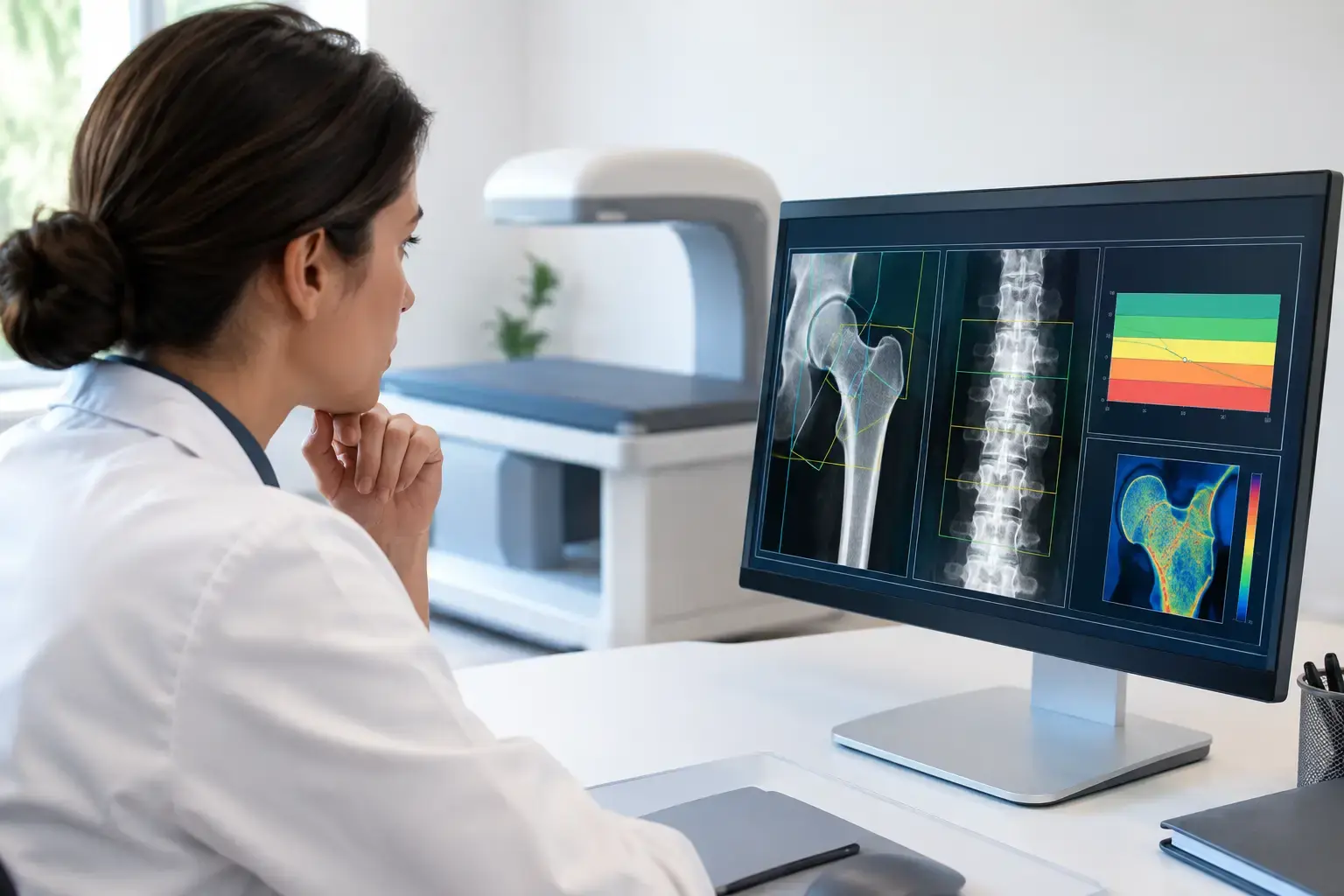
A bone report can look reassuring at first glance, then leave you wondering what it actually says about your future. If you have been told your density is normal, low, or somewhere in between, a fracture risk report review helps turn a collection of measurements into a more useful question: what do these findings mean together for your bones?
That distinction matters because bone mineral density is only one part of skeletal health. It measures how much mineralized bone is present. Fracture risk also relates to signs of fragility that density alone does not capture. A report that includes density, a Fragility Score, and an estimated five-year fracture risk gives you a fuller view than any one number can provide.
What a fracture risk report review is really for
The purpose of reviewing a fracture risk report is not to turn a test result into a prediction carved in stone. It is to make invisible information visible before a fracture forces the conversation.
A useful review asks three connected questions. How much mineralized bone is present? Is the bone showing ultrasound-signal characteristics associated with greater fragility? And when those findings are considered together, what is the estimated risk of fracture over the next five years?
Those questions are related, but they are not interchangeable. A density result tells you about quantity. It does not independently describe every feature associated with bone fragility. That is why two people with similar bone mineral density can have different overall risk profiles.
One person may have a density result in the same range as another person, while their reflected ultrasound signals produce a different Fragility Score. The point is not that density is unhelpful. Density remains clinically meaningful and is part of fracture-risk assessment. The point is that the same density number does not always tell the whole fragility story.
Start with bone mineral density
Bone mineral density, often abbreviated BMD, is the familiar starting point. It reflects the amount of mineralized bone at measured skeletal sites, commonly the lumbar spine and proximal femur. Reports may also include T-scores, which compare an adult's density with the average density of a healthy young reference population.
A lower T-score can identify low bone mass or osteoporosis within established diagnostic frameworks. But a T-score is not a complete description of whether a bone will fracture. Bone tissue is biologically active. It responds to age, hormones, loading, illness, medications, nutrition, and many other influences over time.
This is especially relevant during perimenopause and menopause, when bone loss can accelerate before routine screening is commonly offered. It also matters after a diagnosis of osteopenia or osteoporosis, when it is natural to want more information than a single category can provide.
Density can be particularly incomplete in type 2 diabetes. People with type 2 diabetes may have bone density that reads as normal or even higher than expected while their fracture risk remains elevated. Researchers believe several mechanisms contribute, including changes in bone material properties related to chronic high glucose exposure, altered bone turnover, and a greater likelihood of falls in some individuals. A normal density result in this setting deserves context, not automatic reassurance.
Read the Fragility Score as separate information
With REMS technology, the Fragility Score is derived independently from raw ultrasound signals reflected from bone. REMS measures bone mineral density at the lumbar spine and proximal femur, then analyzes features in those reflected signals associated with skeletal fragility.
The Fragility Score is not another version of density, and it is not a measure of bone flexibility, microarchitecture, failure load, or every biological feature that affects fractures. It is an independent signal-based measure intended to add information beyond BMD.
That independence is the reason it belongs on the report. When density and the Fragility Score tell a similar story, the findings may be more internally consistent. When they differ, the difference is not necessarily an error or a cause for alarm. It is a reason to look more carefully at the whole clinical picture.
For example, someone with modestly reduced density and a lower-fragility signal may have a different discussion with their clinician than someone with similar density and a higher Fragility Score. Personal history still matters. Prior fractures, age, family history, menopause timing, medication exposure, diabetes, cancer-treatment history, body-weight changes, and fall risk can all shape what the numbers mean.
A report provides objective information. Your clinician places that information alongside the rest of your health history.
Understand the five-year fracture-risk estimate
The estimated five-year fracture risk is where the report brings density and Fragility Score together. Rather than asking you to mentally reconcile two separate measurements, the estimate translates their combined relationship into a time-based risk assessment.
This number is best understood as an estimate, not a guarantee. It cannot tell you whether a fracture will or will not happen to you. No scan can account perfectly for future falls, changing medications, new illnesses, changes in mobility, or every factor that affects skeletal health.
Still, time-based risk can be more actionable than a density category alone. It gives you and your clinician a clearer basis for discussion, especially if you are deciding whether to establish a baseline, monitor a known concern, or bring objective bone information to an orthopedic or other medical appointment.
A risk estimate can also help correct a common misunderstanding: a result outside the osteoporosis range does not automatically mean fracture risk is low, and an osteoporosis-range density result does not explain every aspect of risk on its own. The value lies in seeing the measures together rather than treating one result as the entire answer.
Look for patterns, not a verdict
A report is most useful when it becomes part of a pattern over time. Bone status changes slowly in many circumstances, but not always. Hormonal transition, long-term glucocorticoid use, cancer treatment, significant weight loss, and some chronic conditions can change the context more quickly.
This is where measurement precision matters. REMS is radiation-free and FDA-cleared. Its reported intra-operator precision error is below 0.5%, compared with the 0.9% to 1.9% typically reported for DXA at the spine. Lower measurement error does not make every small difference clinically meaningful, but it improves the ability to distinguish a real change from ordinary measurement noise.
For follow-up, the most informative comparison is usually made under consistent conditions: the same technology, the same anatomical sites, and an interval that makes sense for the question being asked. A report from one day is a baseline. A series of comparable reports can show direction.
That distinction is useful if you are already tracking cardiometabolic markers, strength, body composition, or other health data. Bones deserve the same basic discipline: establish a meaningful measure, understand what it does and does not capture, then look for change with context.
Questions worth bringing to your clinician
A fracture risk report review should leave you with better questions, not a self-diagnosis. You might ask how your density, Fragility Score, and five-year estimate fit with your age and health history. If you have diabetes, a history of glucocorticoids, rapid weight loss, or treatment that may affect bone, ask whether those factors change the interpretation of your result.
It can also help to ask what would count as a meaningful change on a future measurement and whether a follow-up assessment would answer a specific clinical question. The answer depends on your starting point, your history, and what decisions are on the table.
Bone health is not reduced to one score, and uncertainty is not the same as bad news. The value of a well-read report is that it gives you a clearer place to begin: information about your bones while you still have time to use it thoughtfully.