
A T-score can be familiar, reassuring, or deeply unsettling - yet it answers only one part of the question most people actually have: how likely is my bone to fracture? Fragility Score versus T-score results are not competing verdicts. They are different kinds of information about the same skeleton.
If you have been told you have osteopenia or osteoporosis, you may be looking at a T-score and wondering whether it tells the whole story. If your density result is normal but you have type 2 diabetes, a history of glucocorticoid use, rapid weight loss, or other risk factors, the question may be even more relevant. Bone mineral density matters. It simply does not describe every signal associated with skeletal fragility.
What a T-score measures
A T-score is a standardized way of reporting bone mineral density, or BMD. It compares your measured density at a site such as the lumbar spine or hip with the average density of a healthy young adult reference population. The number tells you how many standard deviations your result sits above or below that reference average.
A T-score of -1.0 or higher is generally categorized as normal bone density. A score between -1.0 and -2.5 is categorized as low bone mass, often called osteopenia. A score of -2.5 or lower meets the densitometric definition of osteoporosis.
Those thresholds are clinically useful. They create a common language for diagnosis, research, and monitoring. They can also help establish whether density is changing over time.
But density is a quantity measurement. It tells you how much mineralized bone is present in the area measured. It does not directly tell you whether the ultrasound signals from that bone carry more or fewer signs associated with fragility. Two people can have the same T-score and still have meaningfully different fracture risk.
Think of it this way: a T-score tells you how much material is present. It does not, on its own, describe all of the information contained in the bone signal that may be relevant to fragility.
Why density and fracture risk do not always match
Fractures are not determined by density alone. Age, prior fracture, falls, medications, medical history, and other factors affect risk. So can conditions in which bone density may appear less concerning than the fracture data suggest.
Type 2 diabetes is the clearest example. People with type 2 diabetes can have bone mineral density that is normal or even higher than expected while experiencing higher fracture risk. The reasons are still being studied, but diabetes-related changes in bone tissue, fall risk, and complications that affect balance or vision may all contribute. A density-only result can therefore look falsely reassuring in this setting.
That does not mean a normal T-score is meaningless, or that a lower T-score guarantees a fracture. It means density needs context. Risk is a probability, not a promise, and a measurement is most useful when you understand both what it captures and what it leaves outside the frame.
Fragility Score versus T-score results: the key difference
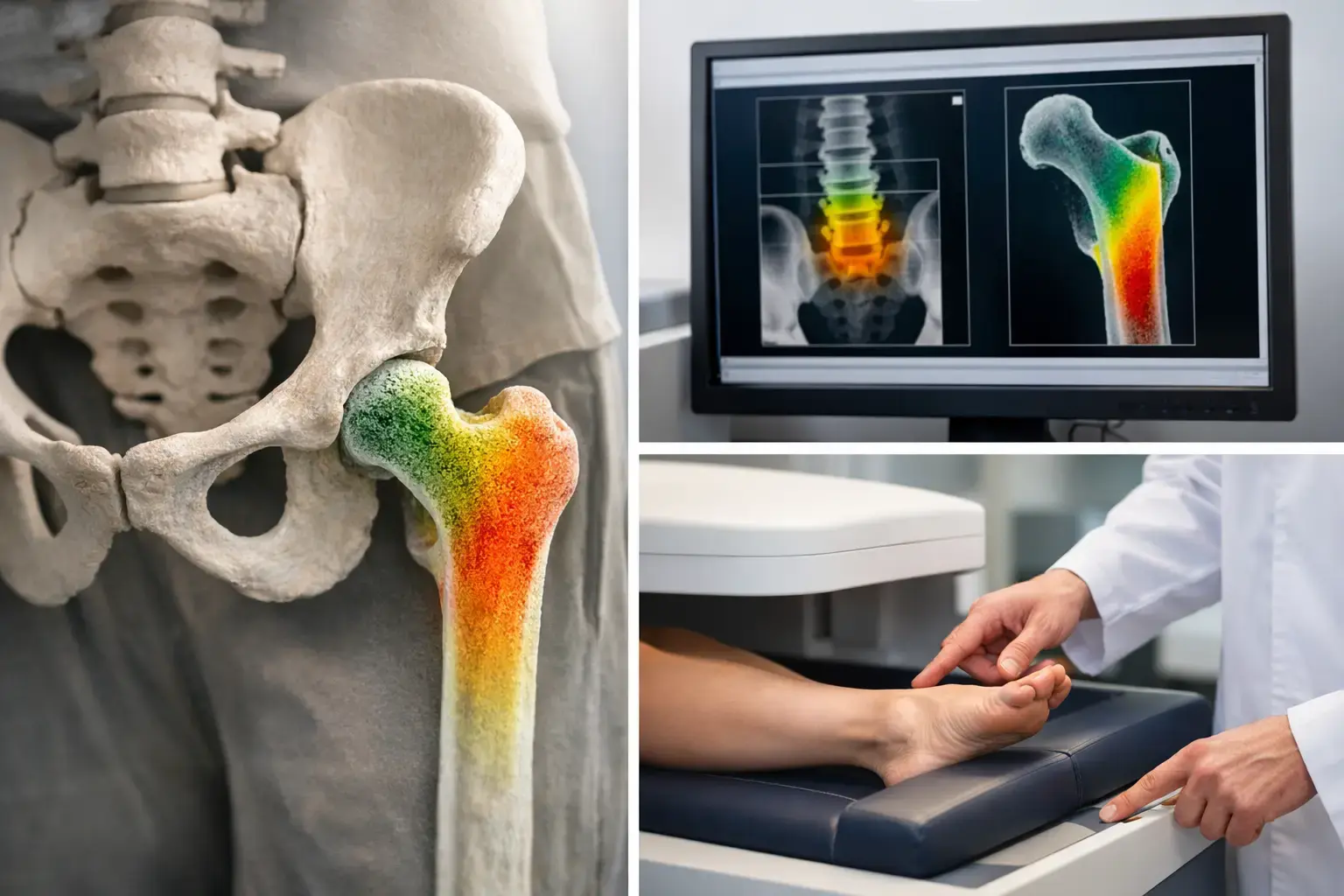
REMS, or Radiofrequency Echographic Multi Spectrometry, measures bone mineral density at the lumbar spine and proximal femur using ultrasound rather than ionizing radiation. It provides a BMD result and related T-score information. It also analyzes the raw ultrasound signals reflected from the bone to derive an independent Fragility Score.
The Fragility Score is not another name for density. It is a separate measure derived from characteristics of the reflected ultrasound signal associated with skeletal fragility. In practical terms, it adds information that a density number alone cannot provide.
A useful comparison is two people whose hip T-scores are both -1.8. Both have low bone mass by densitometric criteria. But one may have a lower Fragility Score while the other has a higher score, indicating more signal-based signs associated with fragility. Their density tells a similar story. Their broader skeletal information does not.
That distinction is especially relevant when a result does not fit the rest of your history. Perhaps your density is not severely reduced, but you have had a low-trauma fracture. Perhaps you are entering menopause, when bone loss can accelerate, and want a baseline that extends beyond mineral quantity. Perhaps diabetes or a medication history adds risk that a T-score cannot fully explain.
The Fragility Score should not be interpreted as a diagnosis by itself, and it does not replace a clinician's judgment. It is an additional, independent piece of information. Its value is in making the assessment less dependent on one number.
What the score does not claim to measure
Clear boundaries matter in bone science. A Fragility Score does not directly measure bone flexibility, microscopic architecture, failure load, or the exact strength of an individual bone. It reflects ultrasound-signal features associated with fragility.
That may sound like a fine distinction, but it protects against overreading any test result. Bone health is biologically complex. Better information does not eliminate uncertainty; it helps define it more honestly.
How REMS combines the information
A REMS assessment provides three related outputs: bone mineral density, an independent Fragility Score, and an estimated five-year fracture risk that weighs density and fragility information together.
The five-year estimate is often the most intuitive way to look at the results because it connects measurement to the question beneath the measurement: what might these findings mean over the next several years? It is still an estimate, not a forecast of a specific event. Falls, new health conditions, treatment changes, and other circumstances can alter risk after the scan.
The advantage is not that one number becomes all-knowing. The advantage is that your assessment can acknowledge that mineral density and ultrasound-derived fragility signals contribute different information.
For someone with a lower T-score and a higher Fragility Score, the combined picture may reinforce concern that density already raised. For someone whose T-score is only mildly reduced but whose Fragility Score is higher, it may reveal a reason not to dismiss the result as minor. And when density and fragility information are both less concerning, the result can provide a more complete baseline for future comparison.
Why precision matters when you are monitoring change
A score is only useful over time if a reported change is likely to be real. Every measurement technology has some degree of precision error - small variations caused by positioning, operator technique, and the instrument itself.
REMS is radiation-free and has reported intra-operator precision error below 0.5%. That is lower than the approximately 0.9% to 1.9% commonly reported for DXA at the spine. This is not a technical footnote. Tighter precision can make it more practical to follow change over months rather than waiting years to know whether a shift is larger than measurement noise.
That can matter during periods when bone status may change more quickly, including the menopause transition, major weight loss, some cancer treatments, or long-term use of medications that affect bone. It also matters when you are establishing a baseline before a bone-related medical decision. A baseline is more than a starting number. It is a reference point for asking better questions later.
Reading your results without reducing yourself to a category
Your T-score remains important because it tells you where your density stands relative to a young-adult reference group and supports established diagnostic categories. Your Fragility Score adds independent information about signal-based signs associated with fragility. The estimated five-year fracture risk brings those findings together in a form that is easier to discuss with your physician or care team.
None of these numbers needs to become an identity. They are measurements of a living system that changes with age, hormones, health conditions, nutrition, activity, medications, and time. Mechanical loading stimulates bone adaptation. Vitamin D participates in bone metabolism. Medical conditions can alter risk in ways density does not always reveal. The point of assessment is to make those conversations more specific.
A bone scan should leave you with more than a label. It should give you a clearer view of what is present now, what deserves attention, and what information you can carry forward before a fracture forces the conversation.