
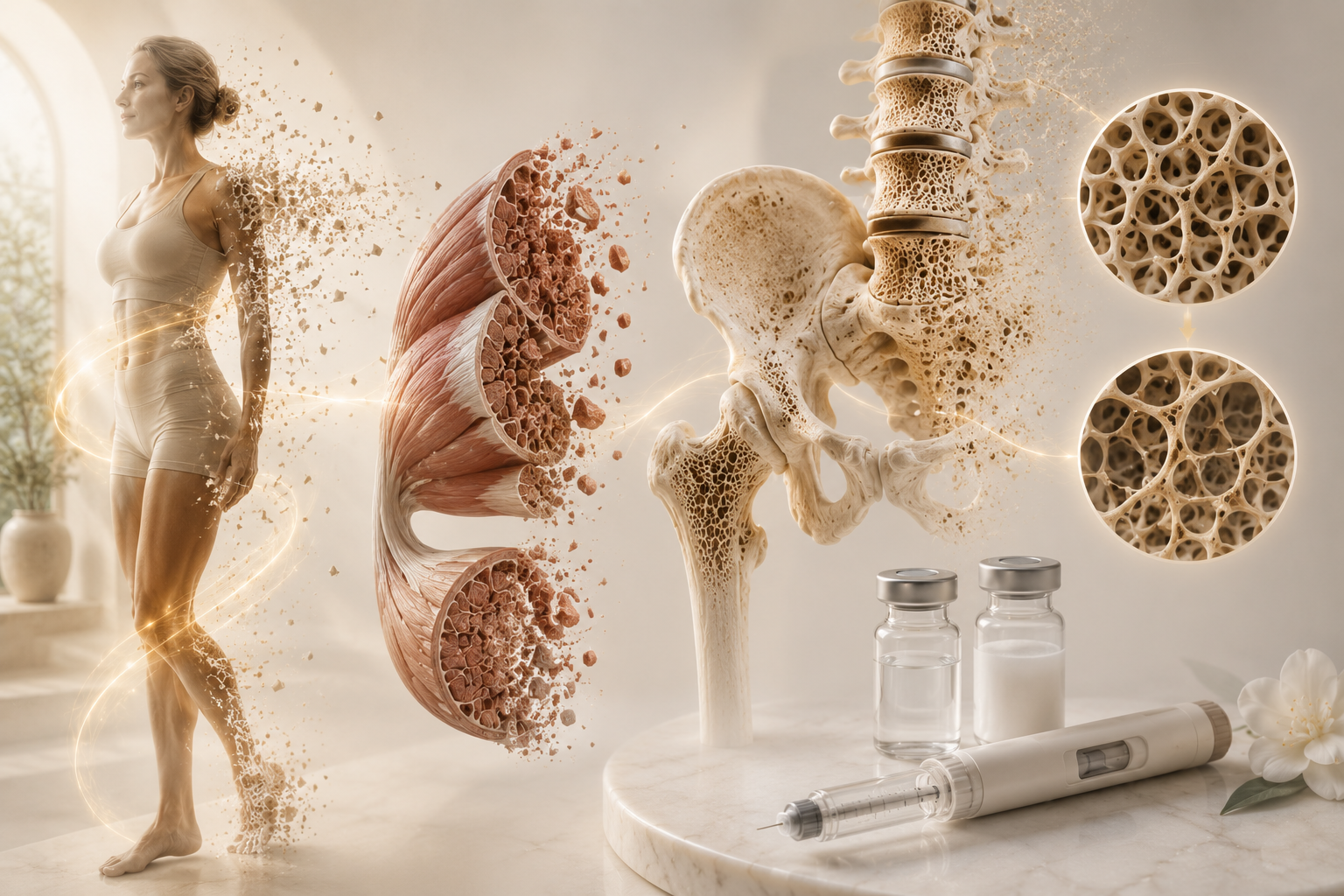
In my practice, I spend my days scanning bones and body composition. And what I've learned watching people change on a GLP-1 is this: the number on the scale tells you almost nothing about what's actually happening inside.
Someone comes in thrilled — down 25 pounds, clothes fitting, energy back. Then I run the scan. Two months in, sometimes less, I can already see it. Muscle: down. Bone density: down. Bone quality — the internal architecture that decides whether a bone holds under load — down too. And the fat they came to lose? In some, barely moved. In a few, it had crept up.
They're lighter. They're also weaker and more fragile than the day they started. The scale called it a win.
Pounds lost isn't the story. What you're losing is.
What a GLP-1 Does to Muscle and Bone
The trials line up with what I see on the scans:
STEP 1 (semaglutide): about 40% of the weight lost wasn't fat — it was lean mass, muscle and bone.
SURMOUNT-1 (tirzepatide): 72 weeks of treatment cut lean body mass by nearly 11%.
Hansen 2024 (semaglutide): a single year dropped hip bone density 2.6% and spine density 2.1% — with bone breakdown rising and no new bone forming to replace it.
A healthy adult loses maybe half a percent of bone a year. This is years of that, compressed into months.
Muscle isn't vanity. It's your metabolic engine and the thing that catches you when you trip. Bone is the frame underneath it. Lose both while your fat holds steady, and you've made yourself smaller and more fragile — the exact opposite of why most people start.

Where Silent Bone Loss Ends
Bone gives no warning. No ache, no stiffness, no bad day. For most people, the first symptom of a weakened skeleton is the sound it makes when it breaks.
So look at the break honestly:
About 300,000 Americans fracture a hip every year.
Within twelve months, 21% are dead — from everything a fracture sets off in a body that was already fragile.
Fewer than half of the survivors ever walk the way they did before.
Half never get their independence back.
That isn't a scare tactic. It's the documented endpoint of bone that thinned quietly, for years, while nobody looked.
The fracture at 74 is written, in part, by what you lost silently at 44. On the medication. This year.
Bone gives no warning. For most people, the first symptom is the break.
How to Protect Bone on a GLP-1
Here's the part that should make you exhale: none of this is inevitable.
GLP-1s don't appear to attack bone or muscle directly. The loss comes from dropping weight fast, putting less load through your frame, and eating — and absorbing — far less protein once your appetite fades. Every one of those is something you can act on.
But only if you can see it. You can't adjust what you haven't measured.
The plan is specific:
Load your skeleton and muscles with strength training — the signal both tissues need to hold on.
Get enough protein, and actually digest it. GLP-1s slow your gut down, so absorption matters as much as intake.
Take a baseline now, then measure again at eight to twelve weeks — and adjust while there's still time.
See What the Scale Can't
A REMS scan reads bone density and bone quality and returns a direct 5-year fracture risk score. It captures body composition in the same session, so you see muscle and fat — not just pounds.
There's no radiation. That means it can be repeated every few months, on the same clock as your medication.
A hospital DEXA gives you density alone, once every couple of years, with radiation — and most people under 65 won't even qualify for a covered one. REMS is built for a body that's changing right now. MobileREMS brings it to you, across the South Puget Sound and Western Washington.
You made a deliberate, data-backed decision about your weight. Bring the same thinking to what the weight is made of. One scan tells you where your muscle, bone, and fat stand — a baseline you can capture once, and never recreate after the fact.
Your scan is just the beginning.
Book your 45-minute REMS assessment — radiation-free, with your bone density, bone quality, 5-year fracture risk, and body composition reviewed in the same session.BOOK A SCAN
This information is for educational purposes only and does not constitute medical advice, diagnosis, or treatment. Bone and muscle changes associated with GLP-1 medications are a documented clinical concern, not a proven outcome in every patient. REMS assessment at Longevia Health Center provides bone density and body composition data for informational purposes. Consult your healthcare provider for medical guidance and before making changes to any medication.