
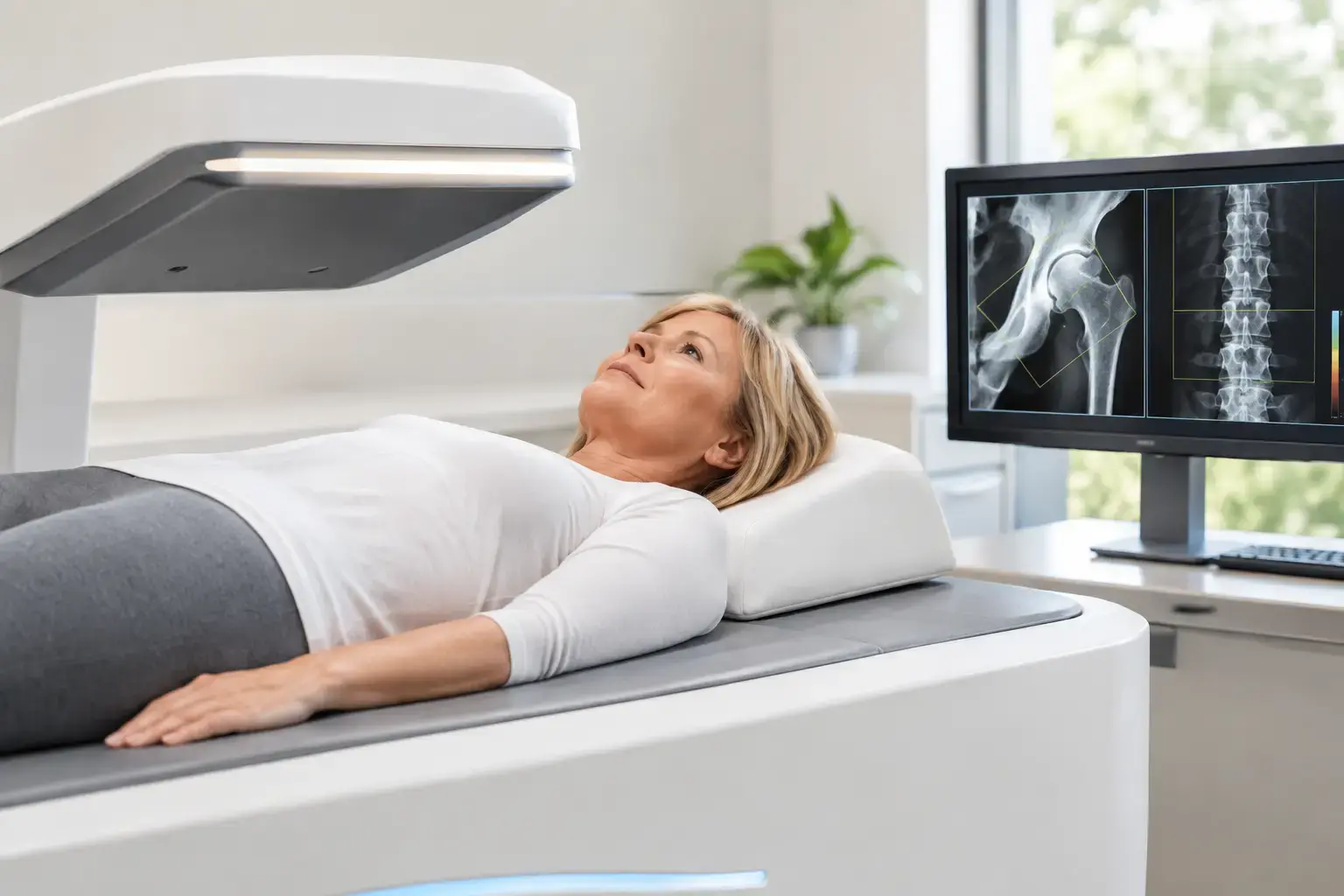
A menopause bone baseline is most useful before you have a reason to worry. The years around your final menstrual period can bring a faster change in bone than many people expect, yet routine osteoporosis screening often begins much later. If you track cholesterol, glucose, or body composition, it is reasonable to ask a similar question of your skeleton: what is true of my bones now, and what can I follow over time?
That question is not about predicting a bad outcome. It is about replacing a blind spot with usable information while there is still time to understand the pattern.
Why menopause changes the bone conversation
Estrogen helps regulate bone remodeling, the ongoing process in which old bone is removed and new bone is formed. Remodeling continues throughout life. During the menopause transition, falling and fluctuating estrogen levels can shift that balance toward more bone resorption than formation. Bone mineral density can decline more quickly, particularly around the final menstrual period and the years that follow.
The rate and extent of change vary. Genetics influences the amount of bone you built earlier in life, often called peak bone mass. Body size, nutrition, physical activity, smoking, alcohol exposure, certain medications, medical conditions, menstrual history, and the timing of menopause all contribute. A person entering menopause at 48 does not have the same risk context as someone entering it after surgical removal of the ovaries at 38.
This is why a baseline matters. Without a starting measurement, a later result can tell you where you are, but not necessarily how quickly you arrived there. A single scan is a snapshot. A well-timed baseline turns future scans into a trend.
What a menopause bone baseline should answer
For decades, bone health has largely been reduced to bone mineral density, usually expressed as a T-score on a DXA scan. Density is valuable. It estimates how much mineralized bone is present at clinically relevant sites, and it remains central to diagnosing osteoporosis.
But density is not the whole fracture story.
Imagine two women with similar bone mineral density at the hip. Their density results may place them in the same category, yet one may have ultrasound signal features associated with greater skeletal fragility. A density number alone cannot distinguish that difference. It tells you the amount of mineralized bone, not all of the information that may be associated with how vulnerable that bone is to fracture.
A meaningful menopause bone baseline therefore has three useful parts:
- bone mineral density at the lumbar spine and proximal femur
- an independent measure of fragility-related information
- an estimate of fracture risk that considers both
The value is not in collecting numbers for their own sake. It is in knowing what each number represents and whether the story they tell is consistent.
Density matters, but it has limits
A T-score compares your bone mineral density with the average peak density of a young reference population. A Z-score compares it with people of similar age, sex, and, in many cases, ethnicity. These are different tools for different clinical questions.
A low T-score can identify osteoporosis and help guide a conversation with your clinician. A result in the osteopenia range indicates lower-than-average density but does not, by itself, reveal a person’s full fracture risk. Fractures also occur in people whose density does not meet the threshold for osteoporosis.
That gap is especially familiar in conditions where density can look reassuring while risk is more complicated. Type 2 diabetes is the clearest example: bone mineral density may be normal or even higher than expected, while fracture risk is still elevated. The mechanisms are still being studied, but changes related to long-term glucose exposure and bone material quality are among the proposed contributors. The practical lesson is straightforward: a normal density result is useful information, not a universal all-clear.
Menopause does not automatically mean your density is low or that a fracture is likely. It does mean the biology is changing at a time when an earlier measurement can make later change visible.
What REMS adds to the baseline
REMS, or Radiofrequency Echographic Multi Spectrometry, is an FDA-cleared, radiation-free ultrasound approach that measures bone mineral density at the lumbar spine and proximal femur. It also analyzes raw ultrasound signals reflected from bone to derive a Fragility Score.
The Fragility Score is independent of density. It reflects signal characteristics associated with skeletal fragility that bone mineral density alone does not capture. REMS then weighs density and the Fragility Score together to estimate five-year fracture risk.
That distinction matters. REMS does not claim to measure every feature of bone strength, nor does any scan eliminate clinical judgment. It provides additional information beyond density: how much mineralized bone is present, whether the reflected ultrasound signal shows greater signs associated with fragility, and what those findings together mean for estimated fracture risk.
For someone entering menopause, this can create a more complete starting point than density alone. If density and fragility information point in the same direction, the result may make the picture clearer. If they do not, the mismatch is also useful. It gives you and your clinician a more informed question to discuss rather than a falsely simple answer.
Why precision matters when you are building a trend
A baseline is only as useful as the ability to compare it with future measurements. Every measurement tool has some degree of variation. If the expected variation is large, a small apparent change may be noise rather than a biological shift.
REMS has reported intra-operator precision error below 0.5%, compared with the 0.9% to 1.9% range typically reported for DXA at the spine. This is not merely a technical advantage on a specification sheet. Tighter precision supports the ability to monitor changes over shorter intervals when a clinician believes repeat measurement is relevant.
That does not mean every person needs frequent scanning. The appropriate timing depends on your age, menopause stage, baseline findings, medical history, medications, and the decisions being considered. It does mean that when monitoring is warranted, the question can be more specific: is this a real change in bone, or just variation in the measurement?
When an earlier baseline may be particularly informative
The menopause transition is one reason to establish bone information, but it is not the only one. Earlier assessment can be especially relevant when menopause overlaps with other factors known to affect skeletal health, including long-term glucocorticoid use, a history of cancer treatment, early or surgical menopause, a prior low-trauma fracture, rapid weight loss, or medications that may influence bone metabolism.
It can also be helpful before a decision point. Some people want objective information before discussing osteoporosis medication. Others are considering a major weight-loss intervention, preparing for orthopedic surgery, or trying to understand a prior osteopenia result in more detail. A baseline does not make the decision for you. It gives the conversation a firmer foundation.
If you already have a DXA result, that history still matters. Bring it into the discussion. Bone care is not an either-or choice between established density testing and newer information about fragility. The strongest picture often comes from understanding what each measurement can answer, and what it cannot.
The question to carry into midlife
Menopause is a transition, not a diagnosis. It does not erase the bone you built, and it does not make your future unknowable. It is, however, a biologically meaningful period when silent changes may become faster.
A good baseline makes those changes easier to see before they announce themselves as a fracture. It gives you a record of density, fragility-related information, and estimated five-year fracture risk that you can bring to your physician and revisit as your health changes. The most useful bone conversation is not the one that begins after a consequence. It is the one that gives you a clear view while you still have choices.