
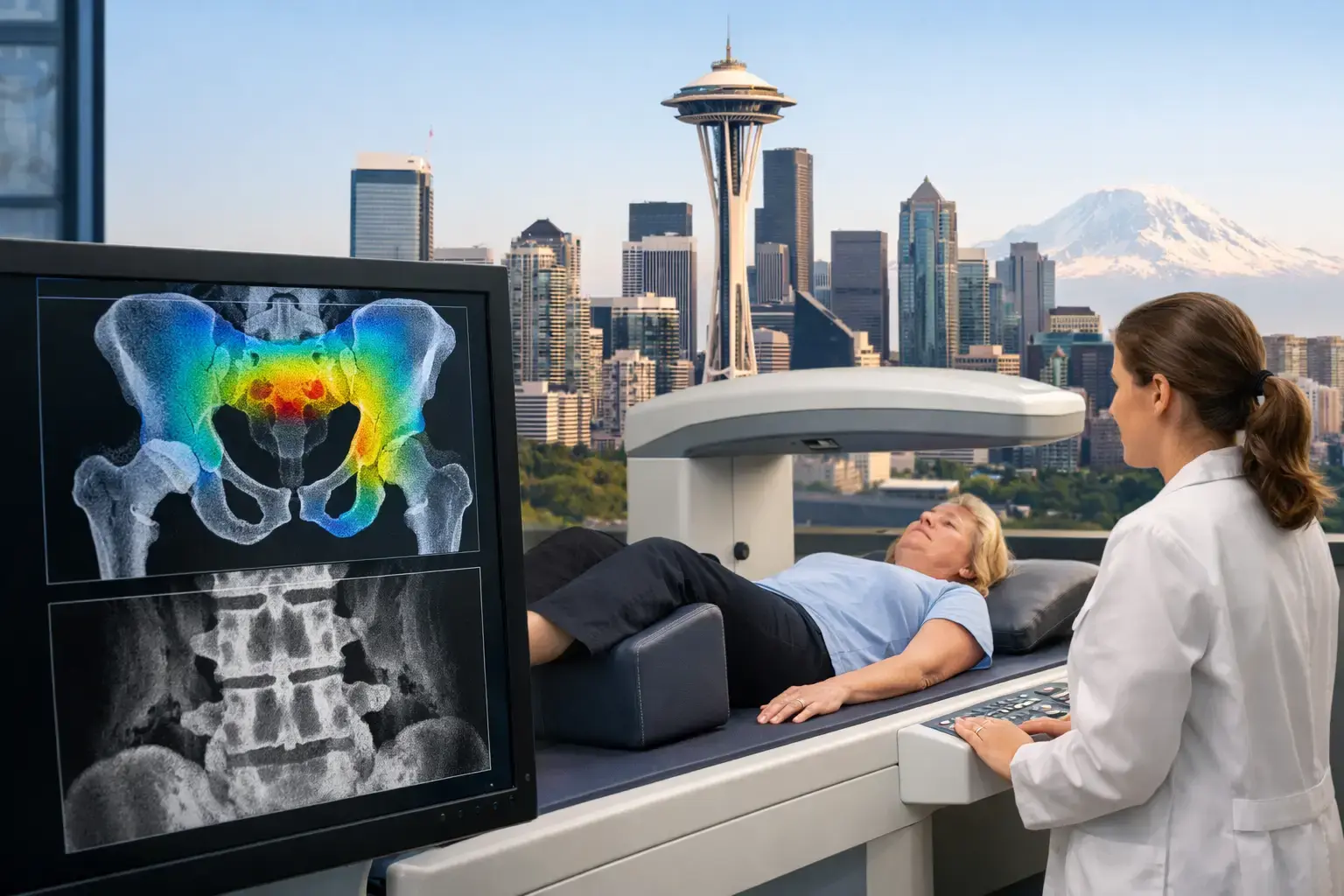
If you are searching for Seattle bone testing, you may already know your bone density matters. The less obvious question is whether density alone tells you enough about how vulnerable your bones may be to fracture.
A T-score can be useful. It compares your bone mineral density to that of a healthy young adult reference population and helps clinicians identify osteopenia or osteoporosis. But density is a measurement of how much mineralized bone is present. It is not a complete readout of fragility.
That distinction matters long before a fracture makes it impossible to ignore. Two people can have similar density results, yet one may show more ultrasound signal patterns associated with skeletal fragility and a higher estimated fracture risk. Bone health is not only a question of quantity. It is also a question of what additional information the bone itself may be revealing.
What Seattle Bone Testing Usually Measures
Most conventional bone testing centers on dual-energy X-ray absorptiometry, known as DXA. DXA remains an established tool for measuring bone mineral density at clinically relevant sites such as the spine and hip. It is widely used, and its role in diagnosis and fracture-risk assessment is well established.
Still, a density result has boundaries. It cannot independently characterize every biological factor that contributes to fracture. Bone remodeling, age, prior fracture history, medication exposure, falls, health conditions, and aspects of bone quality all influence the larger risk picture. A density number is one meaningful part of that picture, not the whole picture.
This is especially relevant if you have type 2 diabetes. People with type 2 diabetes can have bone mineral density that appears normal or even higher than expected while experiencing elevated fracture risk. The reasons are not fully reduced to one mechanism, but diabetes-related changes in bone material properties, accumulated advanced glycation end products, complications affecting balance or vision, and medication effects may all contribute. A reassuring density result should not automatically end the conversation when other risk factors are present.
The same need for context can arise during perimenopause and menopause, after long-term glucocorticoid use, during rapid weight loss, after some cancer treatments, or when considering an osteoporosis medication or orthopedic procedure. In each case, the question is not whether density matters. It does. The question is whether density is the only information worth having.
What REMS Adds Beyond Bone Density
Radiofrequency Echographic Multi Spectrometry, or REMS, uses ultrasound rather than ionizing radiation to assess the lumbar spine and proximal femur. It measures bone mineral density at those sites, then analyzes raw ultrasound signals reflected from the bone.
From those signals, REMS derives an independent Fragility Score. The score reflects signal features associated with fragility that bone mineral density alone does not capture. It is not a measure of bone flexibility, microarchitecture, failure load, or every possible aspect of bone quality. It is a distinct ultrasound-derived indicator designed to add information beyond density.
REMS then considers density and the Fragility Score together to estimate five-year fracture risk. That gives you three related but separate pieces of information: how much mineralized bone is present, whether the ultrasound signal shows more signs associated with fragility, and what the two suggest about near-term fracture risk.
Think of two people leaving a scan with the same bone density. On a density report alone, their stories could look similar. If one person has a higher Fragility Score, however, the REMS result may show that their bone signals do not tell the same story. The difference does not create a diagnosis by itself, and it does not predict a specific fracture with certainty. It does give that person and their clinician a more complete basis for discussion.
For someone who has been told they have osteopenia, this can be clarifying rather than alarming. A T-score identifies lower-than-expected density, but it cannot answer every question about fragility. For someone focused on prevention, a baseline can make an invisible process more understandable before a major health event forces attention to it.
Why Precision Changes the Monitoring Conversation
A bone measurement is most useful when you can trust meaningful change over time. Every measurement technology has some degree of variation. If that variation is wide, a small shift between scans may reflect measurement noise rather than a true biological change.
REMS has an intra-operator precision error below 0.5%, compared with the roughly 0.9% to 1.9% typically reported for DXA at the spine. That difference is not merely technical language for a report. Tighter precision can make it possible to re-measure over months instead of waiting years, with greater confidence that a reported change may reflect your bones rather than the instrument.
This does not mean every small change has the same clinical meaning, or that frequent testing is necessary for everyone. Timing depends on your health history, the reason for assessment, and the decision being considered. It does mean the quality of the measurement affects what monitoring can realistically show.
REMS is FDA-cleared and radiation-free. The technology has also been used in research involving skeletal loss during spaceflight, a setting where bone changes can occur quickly and measurement precision matters. For people who want to follow bone data over time, those properties are practical, not abstract.
When More Than a T-Score May Be Useful
There is no single life stage when bone information suddenly becomes relevant. Peak bone mass is largely built by the late twenties, genetics influences the ceiling, and bone loss can begin gradually from midlife. Yet many adults track glucose, cholesterol, body composition, and fitness data while having no baseline information about their skeleton.
For women moving through perimenopause or menopause, the timing can feel particularly uneven. Bone loss may accelerate during the menopausal transition, while routine population screening often begins later. An earlier assessment cannot forecast every future outcome, but it can replace assumptions with measurable information.
If you have known osteoporosis or osteopenia, additional data can help frame conversations with your physician. The Fragility Score does not simply repeat the T-score. It answers a different, complementary question about ultrasound signal patterns associated with fragility. A five-year fracture-risk estimate can then connect those measurements to the concern that matters most: not only what the scan says, but what it may mean for fracture risk.
For people with diabetes, a history of steroid exposure, rapid weight loss, or treatment histories that affect bone, the value may be in avoiding a false sense of closure. Normal density is good news when it is present. It is not always the final word.
What to Expect From a REMS Assessment
A REMS assessment is performed with ultrasound at the lumbar spine and proximal femur. There is no ionizing radiation, and the visit produces a report with bone mineral density, a Fragility Score, and estimated five-year fracture risk. Those results are designed to be understandable and useful in a clinical conversation.
The report is not a substitute for medical diagnosis, your broader health history, or clinician judgment. Fracture risk is influenced by factors a scan cannot fully capture, including prior fractures, falls, medications, and conditions that affect mobility. But objective bone data can make that conversation more specific.
MobileREMS brings this form of assessment to individuals, practices, and organizations across Western Washington, including the Seattle area. For a person who wants information before consequences, the point is not to chase numbers. It is to understand what the numbers can and cannot tell you.
Your bones do not announce change as clearly as blood pressure or glucose. A thoughtful assessment gives that quiet biology a voice - and gives you something concrete to bring into the decisions that follow.