
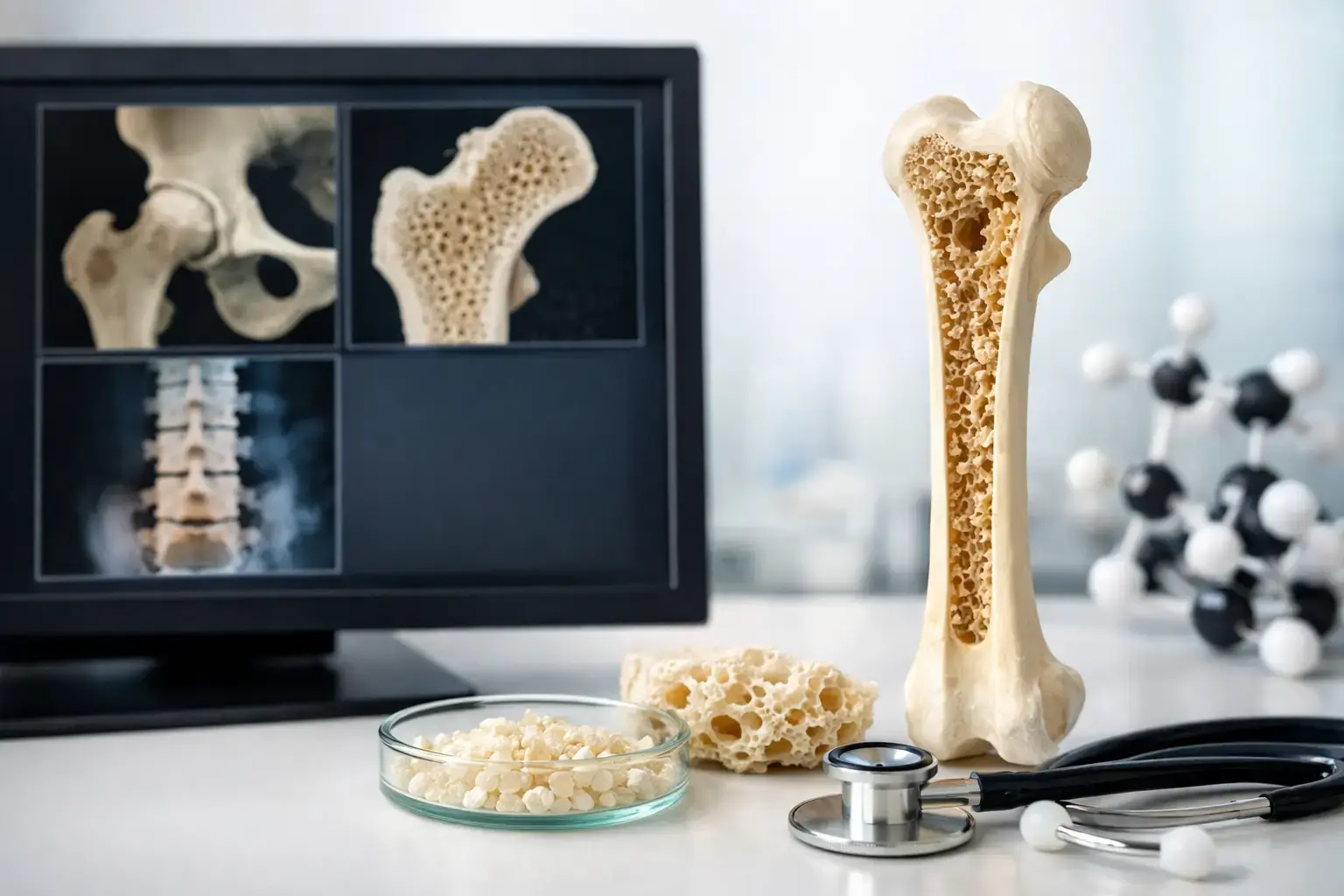
A bone density result can look reassuring and still leave an essential question unanswered: what affects bone fragility in the bone you actually have? This matters if you are in menopause, living with type 2 diabetes, managing osteopenia, or simply tracking your health before a fracture forces the issue.
Bone mineral density is useful. It estimates how much mineralized bone is present. But a fracture is not caused by density alone. It occurs when the demands placed on a bone exceed its ability to hold together, and that ability reflects biology, structure, health history, and time.
What affects bone fragility?
Bone fragility is shaped by the amount of mineralized bone, but also by characteristics of bone that density does not fully describe. Age, hormonal change, certain medical conditions, medications, nutrition, smoking, alcohol exposure, body weight changes, genetics, and prior fractures all influence the picture.
Think of two people with similar bone density at the hip. One may have a lower likelihood of fracture over the next several years; the other may carry higher risk because the bone is showing stronger signals associated with fragility, or because diabetes, a prior fracture, or glucocorticoid exposure changes the clinical context. The density number is real in both cases. It is simply not the whole story.
Bone mass sets part of the starting point
Bone mineral density reflects the concentration of mineralized bone at a measured site, usually the lumbar spine and proximal femur. Lower density is associated with higher fracture risk, which is why T-scores and Z-scores remain central to bone assessment.
Your starting point is influenced heavily by genetics and by the bone mass built in childhood, adolescence, and early adulthood. Peak bone mass is generally reached by the late twenties. From mid-adulthood onward, bone remodeling continues, but the balance can shift toward loss depending on hormones, health conditions, medications, activity, and nutritional status.
That history matters. A density test shows where you are now, not every biological event that brought you there.
Hormones change the remodeling balance
Bone is living tissue. Specialized cells continually remove older bone and form new bone, a process called remodeling. Estrogen helps regulate that balance. During perimenopause and menopause, declining estrogen can accelerate bone loss, sometimes before routine screening would ordinarily begin.
Other hormonal conditions can also affect bone metabolism, including low testosterone, thyroid hormone excess, and disorders involving parathyroid hormone or cortisol. The effect varies by condition, duration, and treatment status. The practical point is that a transition in hormone biology can change bone faster than a single, widely spaced density measurement can make visible.
Type 2 diabetes can create a false sense of security
Type 2 diabetes is one of the clearest examples of why density alone can miss meaningful skeletal risk. Research has repeatedly found that people with type 2 diabetes may have normal or even higher bone mineral density while experiencing a higher risk of fracture than density would predict.
Several mechanisms may contribute. Chronic high blood glucose can lead to advanced glycation end products within bone collagen, altering the material environment of the bone. Diabetes can also affect bone turnover and is associated with complications that may increase fall risk. A normal density result in this setting is not meaningless. It just requires context.
This is a useful distinction for anyone who carefully follows glucose, A1C, blood pressure, and lipids. Your bones deserve the same level of curiosity. A favorable density number should not automatically close the conversation about fragility.
Medications and treatment history matter
Long-term glucocorticoid use is a well-established cause of secondary osteoporosis and fracture risk. These medications can alter bone remodeling and reduce bone formation. The effect depends on dose, duration, underlying illness, and other personal factors.
Cancer treatment histories may also affect bone health through hormone suppression, chemotherapy-related ovarian dysfunction, or other pathways. For someone navigating or recovering from cancer treatment, this is not a reason for alarm. It is a reason to make bone information part of a broader, informed clinical conversation.
Other circumstances can matter as well, including medications that affect hormone signaling, conditions that impair nutrient absorption, chronic inflammatory disease, kidney disease, and prolonged periods of reduced mobility. No one factor tells the entire story. Risk emerges from how factors combine.
Rapid weight change can affect the skeleton
Body weight and bone are connected, though not in a simplistic way. Mechanical loading stimulates bone adaptation, and significant weight loss can reduce that loading. Changes in lean mass, nutrient intake, hormone signaling, and overall energy balance may also affect bone remodeling.
This is relevant for people losing weight rapidly, including those using GLP-1 medications. These therapies can have important metabolic benefits, and the bone question is not a verdict on any treatment. It is a reminder that a changing body composition can be a changing skeletal context, worth measuring rather than assuming.
Falls and prior fractures change the real-world equation
Fragility is not only about the bone. A fracture requires an event, often a fall, and fall risk rises with factors such as impaired vision, neuropathy, certain medications, reduced muscle function, and balance changes.
A prior low-trauma fracture is especially meaningful because it documents that the bone-fall system has already failed under relatively ordinary force. It does not predict every future outcome, but it belongs in any careful assessment of fracture risk, even if density is not dramatically low.
Why density does not fully explain bone fragility
DXA has long been the standard tool for measuring bone mineral density, and it remains clinically valuable. Yet density is a quantity measure. It cannot independently characterize all of the biological and structural signals associated with fragility.
This does not mean density is wrong. It means a density-only framework can leave uncertainty, particularly when a person’s risk factors and their density result do not appear to agree. Type 2 diabetes is the classic example, but it is not the only one.
The better question is not, “Is density enough or is it not?” It is, “What information does density provide, and what remains unknown?” That shift makes the invisible part of bone health easier to see.
What REMS adds to a bone health assessment
REMS, or Radiofrequency Echographic Multi Spectrometry, uses radiation-free ultrasound to measure bone mineral density at the lumbar spine and proximal femur. It also analyzes raw ultrasound signals reflected from the bone to derive an independent Fragility Score.
The Fragility Score reflects signals associated with skeletal fragility that density alone does not capture. It is not a measure of flexibility, failure load, or a direct image of microarchitecture. Its value is more specific: it adds independent information about fragility alongside the density result.
REMS then weighs density and the Fragility Score together to estimate five-year fracture risk. Instead of leaving with one number, you have three connected pieces of information: how much mineralized bone is present, whether the reflected signal shows greater signs of fragility, and what those findings may mean together for near-term fracture risk.
That distinction can be particularly useful when you have osteopenia and want more context than a T-score provides, when diabetes makes a normal density result harder to interpret, or when you want a baseline before a major health transition.
Precision also affects what monitoring can mean. MobileREMS uses FDA-cleared REMS technology with an intra-operator precision error below 0.5%, compared with the 0.9% to 1.9% typically reported for DXA at the spine. Lower measurement error supports meaningful repeat assessment over shorter intervals, because a reported change is less likely to be instrument noise.
Bone information before consequences
Some factors affecting bone fragility cannot be changed. Genetics, age, and aspects of medical history are part of your starting point. Others are modifiable or manageable in partnership with a clinician. But the first step is not guessing which category you belong in. It is understanding the information your bones are already offering.
A fracture is a late signal. A thoughtful assessment gives you a chance to see the earlier ones, ask better questions, and bring clearer data into the decisions ahead.