
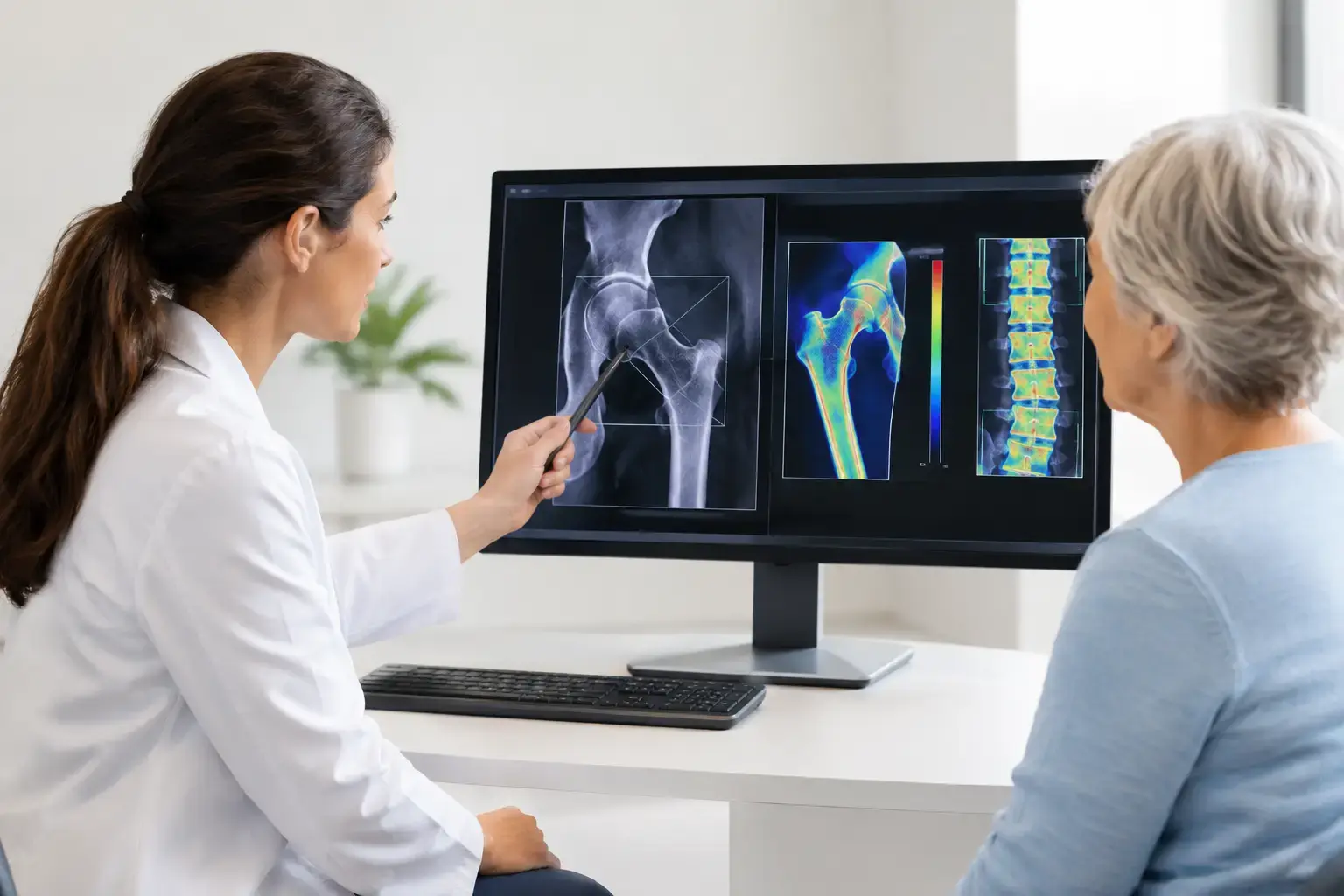
A bone density result can feel definitive: normal, low bone mass, or osteoporosis. But if you have already had a fracture from a fall that would not normally break a healthy bone, that event adds information a density number cannot erase. Bone density versus fracture history is not a contest between two measures. It is a question of how to understand both pieces of evidence together.
A fracture is not simply an outcome to record after the fact. In the right clinical context, it is evidence that the skeleton has already failed under a relatively modest force. Density helps explain how much mineralized bone is present. Fracture history shows that, at least once, the balance between bone strength and real-world force may not have held.
Why fracture history carries so much weight
Clinicians pay close attention to a prior fragility fracture because it is one of the strongest predictors of another fracture. A fragility fracture generally means a break resulting from a fall from standing height or less, though the details matter. A fracture sustained in a high-speed collision, a major sports impact, or another high-energy event does not carry the same implication about skeletal fragility.
Location matters, too. Hip and vertebral fractures are particularly significant, and vertebral fractures can occur with little drama - sometimes after bending, lifting, or no clearly remembered event at all. Wrist, upper arm, pelvis, and certain other fractures can also be clinically relevant depending on age, mechanism, and the person’s broader health picture.
This is why a previous fracture changes the conversation even when a DXA report does not show osteoporosis by T-score. The prior event is not proof of every aspect of bone biology, nor does it tell a clinician exactly why the fracture occurred. It does say that a risk model based on density alone is incomplete.
The distinction between a risk factor and a record of failure
Low bone mineral density is a risk factor. It identifies less mineralized bone, on average, than is expected in a reference population. It is useful, validated information, and it remains central to bone-health assessment.
A prior fragility fracture is different. It is a clinical event. Think of it as the difference between seeing a warning light on a dashboard and learning that the car has already stalled under ordinary driving conditions. Both facts matter. Neither gives the entire mechanical explanation on its own.
Age, falls, medications, medical conditions, and family history also shape fracture risk. So does the location of the density measurement. A spine T-score and a hip T-score may not tell the identical story because bone loss and degenerative changes are not distributed evenly throughout the body.
Where bone density versus fracture history can disagree
Two people can have the same bone mineral density and carry meaningfully different fracture risk. One may have no fracture history, no major secondary causes of bone loss, and a stable pattern over time. The other may have had a low-trauma wrist fracture, use long-term glucocorticoids, or live with type 2 diabetes. The density number may be similar. The clinical meaning is not.
Type 2 diabetes is the clearest example of why a reassuring density result deserves context. People with type 2 diabetes may have bone mineral density that appears normal or even higher than expected, while their fracture risk remains elevated. The mechanisms are still being studied and are not reduced to one single cause. Changes in bone material properties, diabetes-related complications that affect falls, and metabolic factors may all contribute.
The point is not that density is wrong. It measures what it measures: the amount of mineralized bone at the scanned site. It does not directly capture every signal associated with skeletal fragility or every factor that influences whether a fall becomes a fracture.
Fracture history has limits as well. Someone can have no prior fracture and still have substantial risk, either because they have not fallen yet or because bone changes are silent. Conversely, a person may have had a fracture many years ago under circumstances that require careful interpretation rather than a quick label. Good assessment does not elevate one data point by dismissing another.
What density can tell you, and what it cannot
Bone mineral density is typically reported as a T-score or Z-score. A T-score compares your density with that of a healthy young adult reference population. A Z-score compares it with people of similar age and sex. These measures help identify low bone mass and osteoporosis, guide diagnostic discussions, and establish a baseline for monitoring.
What a density result cannot do by itself is fully explain the structural signals within the bone that may be associated with fragility. It cannot tell you whether a previous fracture was incidental, whether a future fall will happen, or how medications, diabetes, rapid weight loss, menopause, or cancer treatment affect an individual person’s overall risk.
That is why risk assessment has always required more than one input. A careful history remains essential. The question is not, “Which matters more, density or fracture history?” The more useful question is, “What does each one add that the other cannot?”
How REMS adds information beyond density
REMS, or Radiofrequency Echographic Multi Spectrometry, measures bone mineral density at the lumbar spine and proximal femur using radiation-free ultrasound. It then analyzes the raw ultrasound signals reflected from bone to derive an independent Fragility Score.
That distinction matters. The Fragility Score is not another name for bone density, and it is not a diagnosis of fracture. It reflects signal characteristics associated with fragility that density alone does not capture. REMS weighs bone density and the Fragility Score together to estimate five-year fracture risk.
For someone comparing bone density versus fracture history, this creates a more complete framework. A prior fragility fracture remains clinically meaningful. Density establishes how much mineralized bone is present. The Fragility Score adds independent information from the reflected ultrasound signal, and the estimated risk integrates the measures into a forward-looking picture.
MobileREMS reports these as three understandable results: bone density, Fragility Score, and estimated five-year fracture risk. The report can support a more informed conversation with the clinician who knows your medical history, medications, prior imaging, and fracture details.
Monitoring is part of the value of better measurement
Bone health is not static, particularly during transitions such as menopause, rapid weight loss, long-term glucocorticoid use, or treatment for conditions that affect bone metabolism. Yet small changes are only meaningful if the measurement is precise enough to distinguish real change from testing variability.
REMS is FDA-cleared and radiation-free, with an intra-operator precision error below 0.5%. That is tighter than the 0.9% to 1.9% typically reported for DXA at the spine. Precision does not predict every individual outcome, but it matters when you want to follow a trend in months rather than waiting years to know whether a reported change is likely to be real.
Questions worth bringing to your bone-health conversation
If you have had a fracture, the details are worth documenting: your age at the time, which bone was involved, and what happened immediately before it. A fall from standing height has a different meaning than a fall from a ladder. A vertebral fracture found incidentally on imaging may deserve a different discussion than a childhood arm fracture.
It can also help to ask whether your density result and your clinical history tell a consistent story. If they do not, that does not automatically mean one is mistaken. It may mean you need a broader view of skeletal fragility, particularly if you have type 2 diabetes, use medications known to affect bone, or are navigating menopause or another period of accelerated bone change.
Your bones do not need to wait for a fracture to become worth measuring. And if a fracture has already occurred, it does not have to be the only information you carry forward. The useful next question is simply what the full picture can show you now.