
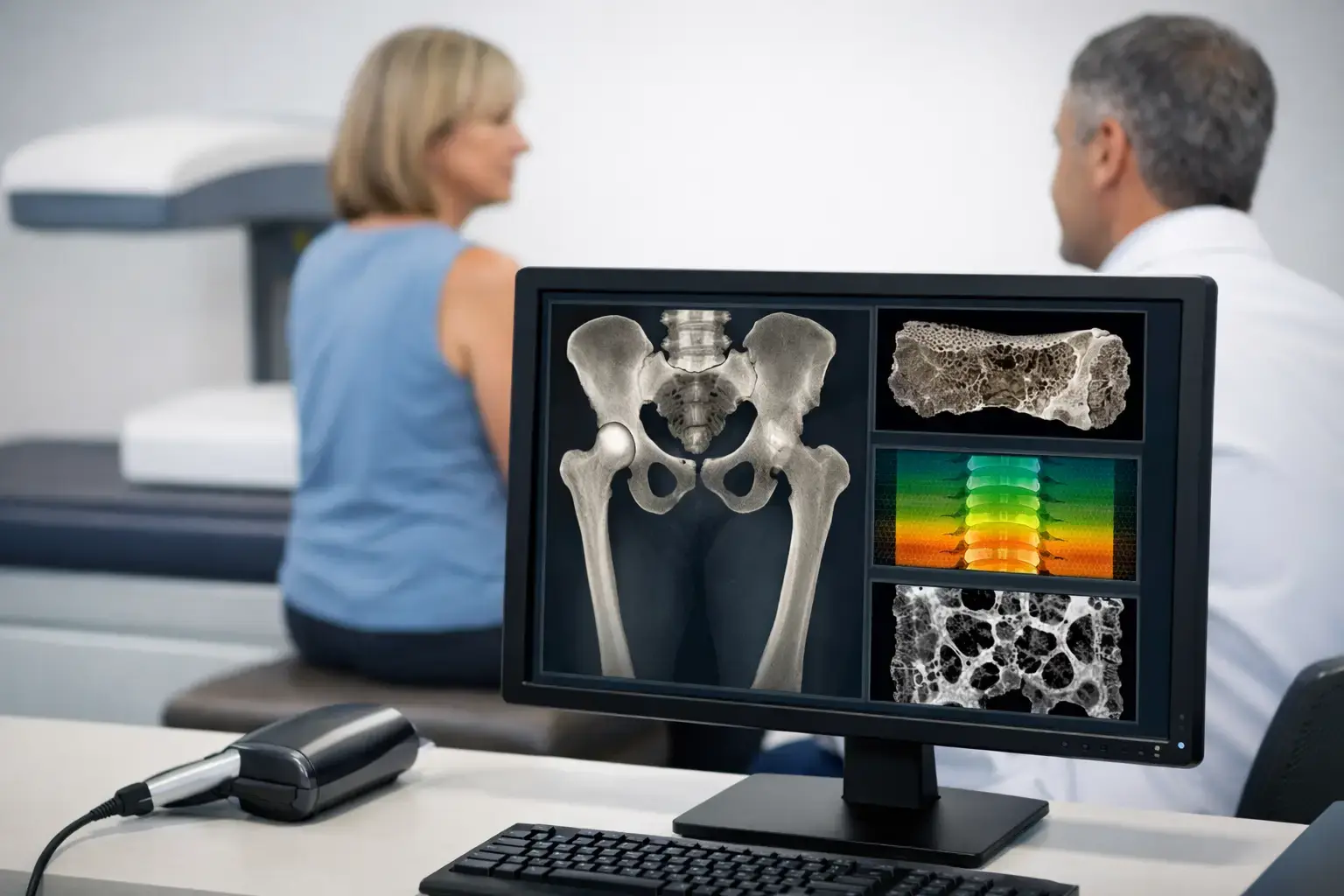
A normal-looking bone density result can be reassuring - and still leave a meaningful question unanswered: what signs of fragility is the bone showing? That is the purpose of a bone fragility assessment. It separates the amount of mineralized bone you have from information about whether the bone is showing signal patterns associated with greater skeletal fragility.
For many adults, this distinction becomes relevant before any diagnosis or fracture. You may be moving through menopause, managing type 2 diabetes, considering an osteoporosis medication, losing weight rapidly, or simply tracking cardiovascular and metabolic health with more attention than anyone has given your bones. A density number is useful information. It is not the whole picture.
What bone density measures - and what it cannot
Bone mineral density, commonly reported as a T-score, estimates the amount of mineralized bone at measured sites. Lower density is associated with higher fracture risk, which is why density testing has long been central to bone-health assessment.
But bones do not fracture based on mineral quantity alone. Fracture risk reflects multiple biological and clinical factors, including age, prior fracture, falls, medications, medical conditions, and characteristics of bone that a density measurement does not directly describe.
Picture two people with the same bone mineral density at the hip. On paper, their density result may look identical. Yet one may have ultrasound signal findings associated with greater fragility while the other does not. Treating those results as equivalent would miss clinically relevant information.
This is not an argument against density. It is an argument against asking density to answer a question it was never designed to answer by itself.
Why a bone fragility assessment matters
Fragility is the practical issue behind bone health. It is the difference between knowing a bone contains a certain amount of mineral and understanding more about its likelihood of fracturing over time.
The gap is especially clear in type 2 diabetes. People with type 2 diabetes can have bone mineral density that is normal or even higher than expected, yet research has consistently shown an elevated fracture risk. Several mechanisms may contribute, including changes related to long-term glucose exposure that affect bone material properties and the higher likelihood of falls in some individuals. A reassuring density result does not erase those factors.
Other situations can create a similar information gap. Long-term glucocorticoid exposure, cancer-treatment history, rapid weight loss, and menopause can all change the context in which a density result needs to be interpreted. Density still matters. The question is whether it tells the full story of fragility for that particular situation.
A well-designed assessment also makes room for time. Bone biology is not static. Menopause can accelerate bone loss. Mechanical loading stimulates bone adaptation. Vitamin D participates in bone metabolism. Changes in body weight, hormones, disease activity, and medication exposure can all matter. One test result is a useful starting point, but understanding change requires measurements precise enough to distinguish a real shift from ordinary test variation.
How REMS adds information beyond density
Radiofrequency Echographic Multi Spectrometry, or REMS, is an ultrasound-based technology that measures bone mineral density at the lumbar spine and proximal femur. It does so without ionizing radiation.
REMS also analyzes the raw ultrasound signals reflected from bone. From those signals, it derives an independent Fragility Score, which reflects signal characteristics associated with skeletal fragility that bone density alone does not capture. The technology then weighs bone mineral density and the Fragility Score together to estimate five-year fracture risk.
That produces three related but distinct pieces of information:
- Bone mineral density, showing how much mineralized bone is present at the measured site.
- A Fragility Score, showing whether the reflected ultrasound signal contains signs associated with greater fragility.
- An estimated five-year fracture risk, integrating those findings into a forward-looking risk estimate.
These measures should not be treated as interchangeable. A Fragility Score is not simply another name for a T-score, and it does not diagnose a fracture, measure flexibility, or directly measure bone strength under load. Its value is that it contributes separate information to the assessment of fragility and fracture risk.
For someone already told they have osteopenia or osteoporosis, this can clarify whether density and fragility findings are telling a similar story or a more complicated one. For someone whose density is not clearly low but who has risk factors that density can miss, it can identify why a single reassuring number may not settle the question.
Precision changes what follow-up can mean
Monitoring only helps when the instrument can detect change reliably. Every measurement has some degree of variability. If the expected variation is larger than the biological change being observed, a small difference from one test to the next may be noise rather than a meaningful shift in the bones.
REMS has reported intra-operator precision error below 0.5%, compared with the roughly 0.9% to 1.9% commonly reported for DXA at the spine. That difference is not a technical footnote. It affects the confidence with which a clinician and patient can interpret serial results.
Greater precision can make it possible to re-measure over months rather than waiting years, particularly when bone health is changing quickly or when a baseline is needed before a significant health decision. The right interval still depends on the clinical context and the question being asked. More frequent testing is not automatically more useful. But when change is worth tracking, measurement precision determines whether the result can be trusted.
REMS is FDA-cleared and radiation-free, which also makes repeat assessment more practical from an exposure standpoint. The same technology has been used in research on skeletal loss related to spaceflight, a setting where bone changes can occur quickly and measurement sensitivity matters.
When an assessment is most useful
A bone fragility assessment is not reserved for a person who has already fractured. In fact, its strongest purpose may be earlier: making invisible changes understandable before consequences force the conversation.
For a person in perimenopause or menopause, an assessment can establish a meaningful baseline during a period when bone loss may accelerate but standard screening is often still years away. For a person with diagnosed osteopenia or osteoporosis, it can add context to a familiar density score and support more informed discussions with a treating clinician.
For prevention-focused adults, the information gap can be surprisingly large. Peak bone mass is generally reached by the late twenties, genetics influences much of the ceiling, and decline can begin from the mid-thirties. Many people track glucose, lipids, sleep, strength, and body composition for years without knowing how much bone they built or how their bone status is changing.
The result is not a verdict. It is objective information to bring into the decisions already in front of you, whether those involve medication discussions, weight-loss monitoring, a planned orthopedic procedure, or a broader approach to healthy aging.
What to do with the results
A useful report gives you numbers that can be understood and followed: density, Fragility Score, and estimated five-year fracture risk. It also gives your physician or qualified healthcare professional a more complete starting point for interpreting those results alongside medical history, medications, laboratory findings, prior fractures, and fall risk.
No scan can replace that clinical context. A fracture-risk estimate is an estimate, not a prediction of an individual future. Equally, a density score alone should not be mistaken for a complete statement about bone fragility.
MobileREMS brings this broader view of skeletal assessment to individuals and provider partners who want information before consequences. The point is not to make you anxious about your bones. It is to replace a partial answer with a clearer one - so the next conversation about bone health can begin with what your bones are actually showing.