
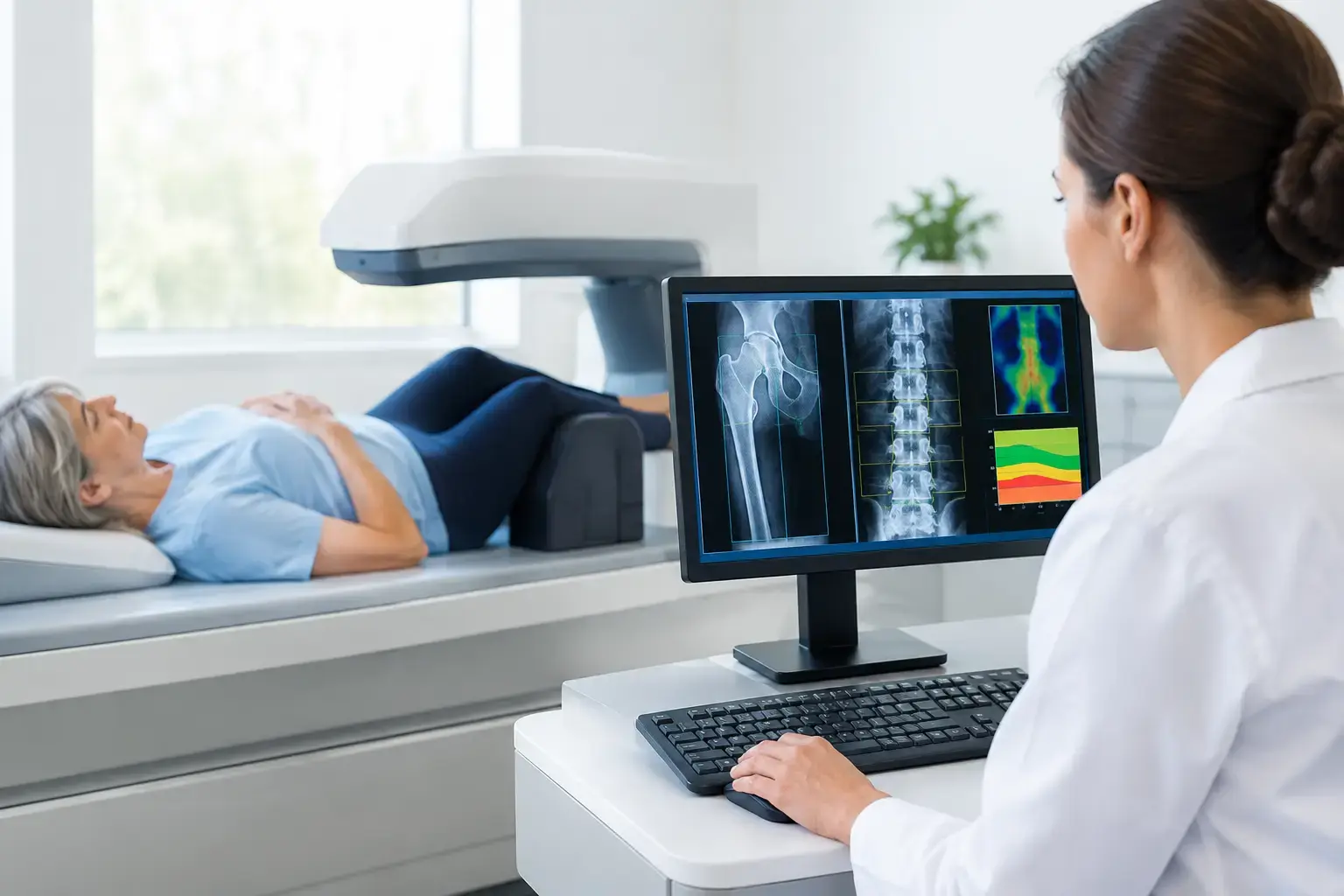
You may be weighing osteoporosis medication after a T-score changed, a fracture occurred, or a clinician raised the question. A bone medication baseline example can clarify what “getting a baseline” actually means: not simply collecting one number before treatment, but documenting the condition of your bones in a way that makes later changes easier to interpret.
That distinction matters because medication decisions are often discussed in the language of bone mineral density. Density is useful. It tells you how much mineralized bone is present. But it does not fully explain why two people with similar density can have different fracture risk, or why a density result that appears reassuring may not settle every question.
Why a baseline matters before bone medication
A baseline is the reference point for a future comparison. Before a medication is started, it records what can be measured at that moment, then gives you and your clinical team a way to ask a more useful question later: what has changed, and is that change likely to be real?
Without a baseline, a later scan may still be valuable, but it is harder to put into context. Was the density already stable? Was it declining quickly? Did the fracture-risk picture suggest greater fragility than the density result alone? Those are different clinical stories, even when the starting T-score is identical.
Medication is only one part of the context. Menopause, prior fractures, family history, long-term glucocorticoid use, cancer-treatment history, rapid weight loss, and type 2 diabetes can all change how a result is understood. In type 2 diabetes especially, bone mineral density may be normal or even higher while fracture risk remains elevated. The mechanisms are still being studied, but changes in bone material properties and diabetes-related complications may contribute. A density-only result can therefore look less concerning than the broader fracture picture.
A baseline does not decide whether medication is appropriate. That is a clinical decision made with your prescribing clinician. It does give the decision a firmer factual starting point.
A bone medication baseline example in practice
Consider a hypothetical 62-year-old woman in the menopause transition. She has not had a fragility fracture, but her mother fractured a hip in her seventies. Her recent DXA result shows osteopenia at the hip. Her clinician is discussing whether medication belongs in the plan now or whether monitoring and other factors should guide the next step.
A density-only baseline might look like this:
- Lumbar spine bone mineral density with a T-score of -1.7
- Femoral neck bone mineral density with a T-score of -2.1
- Total hip bone mineral density with a T-score of -1.8
Those values establish the amount of mineralized bone measured at each site. They do not, by themselves, show every signal associated with skeletal fragility.
Now imagine she also has a REMS assessment. REMS uses radiation-free ultrasound at the lumbar spine and proximal femur to measure bone mineral density. It also analyzes the raw ultrasound signals reflected from bone to generate an independent Fragility Score. The density result and Fragility Score are then considered together to estimate five-year fracture risk.
Her broader baseline record might include her density values, a Fragility Score indicating a higher-fragility signal than density alone suggested, and an estimated five-year fracture risk. It might also document relevant context: menopause timing, family history, medication exposures, prior falls, and whether she has had fractures after low-impact events.
The point is not that a Fragility Score automatically changes the treatment decision. It may or may not. The point is that the conversation is no longer limited to “How much bone is there?” It can also include “Is this bone showing signs associated with greater fragility?” and “What do these findings mean together for fracture risk over the next five years?”
For another person with the same T-scores, the Fragility Score and estimated fracture risk could tell a different story. Similar density does not necessarily mean similar fragility.
What belongs in a useful baseline record
A strong baseline is specific enough to compare later, but it should not create the illusion that one scan contains every answer. Bone health is influenced by biology, medical history, medications, falls, strength, mobility, nutrition, and many other factors.
At minimum, the record usually includes the measured skeletal sites, bone mineral density values, T-scores when applicable, the testing method, and the date. If a REMS assessment is used, it also includes the independent Fragility Score and estimated five-year fracture risk.
The clinical context matters just as much as the scan report. A prior low-trauma fracture, use of glucocorticoids, type 2 diabetes, early menopause, or substantial recent weight loss changes how the numbers may be interpreted. A baseline is most useful when the report and the person’s history stay together rather than being treated as separate files.
It is also worth recording the reason for the assessment. Are you considering medication after a first fracture? Establishing information during perimenopause, when bone loss can accelerate? Monitoring after a medication change or cancer treatment? Preparing for orthopedic surgery? The reason does not alter the measurement, but it helps define the question the measurement is meant to answer.
Why measurement precision changes the monitoring conversation
A number can only be followed over time if the method can distinguish meaningful change from measurement noise. This is where precision becomes practical rather than technical.
Every measurement has some degree of variability. Positioning, instrument performance, and operator technique can all affect a result. If a small difference falls within the expected error range, it may not reflect a biological change in bone.
REMS has an intra-operator precision error below 0.5%, compared with the 0.9% to 1.9% typically reported for DXA at the lumbar spine. Lower measurement error can make shorter-interval reassessment more informative, particularly when a clinician is following a period in which bone may be changing more quickly. It does not mean every change is automatically meaningful, and it does not replace clinical judgment. It means the instrument is better positioned to detect small changes with less noise obscuring the picture.
That is especially relevant when you are establishing a medication baseline. The goal is not to chase tiny fluctuations. It is to have a dependable reference point if the question later becomes whether your bone measurements and fragility-related signals are moving in a favorable, stable, or concerning direction.
Questions a baseline can help you ask
The most helpful baseline is one you understand well enough to discuss. Rather than leaving with only a label such as osteopenia or osteoporosis, you can ask what each measurement means and what it does not mean.
For example: Does my fracture-risk estimate align with my density result? Is there evidence of greater fragility in addition to low density? Which medical factors are most relevant to my risk? What change could this testing method reliably detect over time? And which results would be useful to bring back to the clinician guiding my medication decision?
These questions do not require you to become your own prescriber. They simply make the conversation more precise. That matters when the decision involves trade-offs, preferences, other health conditions, and the uncertainty that can accompany any preventive treatment.
Information before consequences
Starting bone medication can feel like a major threshold, particularly if you have spent years thinking of bone health as a future concern. A clear baseline does not remove every uncertainty, and it should not be used to promise a particular treatment outcome. It gives you a better map of where you are before the next decision is made.
Density remains part of that map. Adding an independent view of fragility and an estimated five-year fracture risk can make the invisible more understandable. Before treatment begins, knowing more about your bones is not a reason for alarm. It is a reason for a clearer conversation.