
A bone-density result can be reassuring and still leave an unanswered question: does the bone show signals associated with greater fragility? That gap is the reason an Echolight REMS clinical review matters. It is not a replacement for clinical judgment, but it gives you more than a single density number to bring into the conversation.
For decades, bone mineral density, or BMD, has been the central measurement in bone health. It remains clinically meaningful. Lower density is associated with higher fracture risk, and DXA-based T-scores are embedded in diagnostic definitions, treatment decisions, and many insurance pathways. But density measures how much mineralized bone is present. It does not fully describe the biological and structural factors that influence whether bone will fracture.
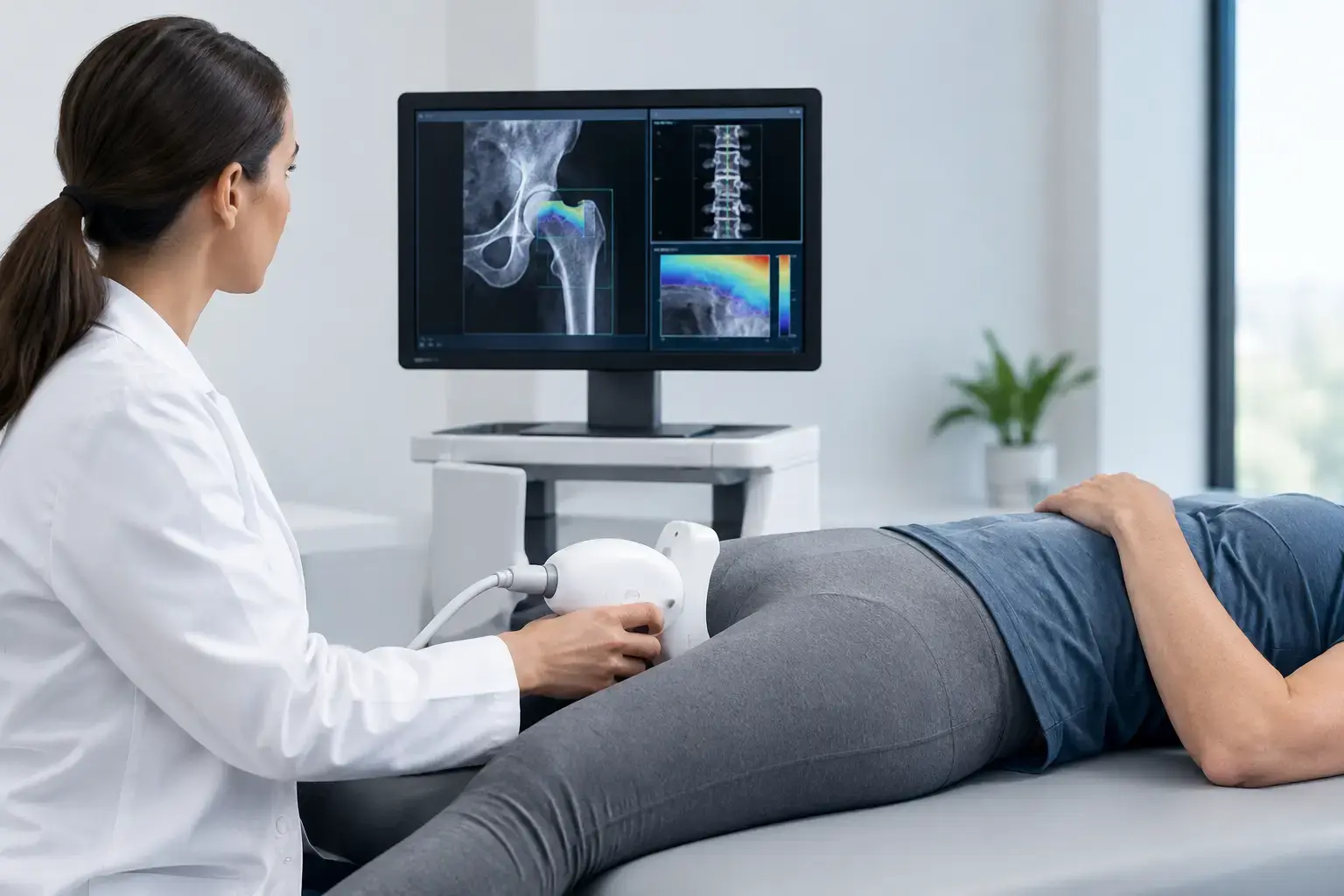
REMS, short for Radiofrequency Echographic Multi Spectrometry, approaches that limitation differently. It uses radiation-free ultrasound at the lumbar spine and proximal femur, the same clinically important sites commonly assessed with DXA. It produces a BMD result, then analyzes the raw ultrasound signals reflected from bone to derive a separate Fragility Score. Those two measures are used together to estimate five-year fracture risk.
What REMS Measures Beyond Bone Density
The distinction is worth making carefully. A Fragility Score is not another way of restating the T-score, and it does not directly measure bone strength, flexibility, microarchitecture, or failure load. It is an independent measure derived from characteristics of the ultrasound signal that have been associated with skeletal fragility and fracture status in clinical research.
Think of two people with similar BMD at the hip. Density tells us that both have a comparable amount of mineralized bone at that site. If one person has a higher Fragility Score, REMS is identifying reflected-signal characteristics associated with greater fragility that density alone does not capture. The result is not a prediction of a specific outcome for either person. It is more complete information about risk.
This difference has particular relevance when density and fracture risk do not always move together. Type 2 diabetes is the clearest example. People with type 2 diabetes may have normal or even higher BMD while experiencing higher fracture risk than BMD alone would suggest. The reasons are multifactorial and can include changes in bone material properties, falls risk, and effects of diabetes on the skeleton that a density measurement does not fully represent. A normal density result is useful information. It is not always the whole story.
The same need for context can arise with long-term glucocorticoid exposure, menopause-related bone loss, cancer-treatment histories, rapid weight loss, and other situations that affect skeletal health. REMS does not erase the need to consider medical history, medications, prior fractures, age, and falls. It adds a distinct data point to that larger clinical picture.
Echolight REMS Clinical Review: What the Evidence Supports
The clinical evidence for REMS supports several measured claims. Studies comparing REMS-derived BMD with DXA have found good agreement at the lumbar spine and proximal femur. That matters because it places REMS BMD in the established framework clinicians already use to discuss bone density.
A separate body of research has examined the Fragility Score in people with and without fragility fractures. In those studies, the score provided information associated with fracture status beyond BMD alone. This is the clinical rationale for combining BMD and Fragility Score into an estimated five-year fracture risk: not because ultrasound can see every property of bone, but because the two REMS outputs contribute different information.
The evidence should be interpreted at the right scale. A risk estimate is not a diagnosis, and it cannot tell you whether you will or will not fracture. No test can isolate bone from the rest of a person's life, including falls, vision, muscle function, medication effects, and underlying disease. A REMS report is best understood as an objective assessment that can sharpen a clinical conversation, especially when the density result feels incomplete or inconsistent with other risk factors.
REMS is FDA-cleared for bone-density assessment. As with any diagnostic technology, clearance does not mean every use case has equal depth of evidence. The strongest clinical foundation is measurement at the lumbar spine and proximal femur, assessment of BMD, and the use of the REMS-derived Fragility Score and fracture-risk estimate as additional information. It should not be presented as a stand-alone substitute for a full evaluation after a fracture or for individualized medical decision-making.
Why Precision Changes the Monitoring Conversation
One of REMS's most practical clinical features is measurement precision. MobileREMS uses Echolight REMS technology with an intra-operator precision error below 0.5%. For context, commonly reported DXA precision errors at the spine are often around 0.9% to 1.9%, though performance varies by site, device, operator, and facility.
Precision is not a technical detail reserved for a report's fine print. Every measurement contains some variability. If that variability is large, a small change from one scan to the next may be noise rather than a real biological change. Lower measurement error makes it more plausible that a measurable change reflects something happening in the skeleton.
That has implications for timing. DXA is often repeated on longer intervals partly because detecting small changes requires enough time for change to exceed measurement variability. With REMS, the tighter precision can support meaningful reassessment over shorter periods when a clinician or individual is tracking a relevant transition. The appropriate interval still depends on the question being asked, the person's health context, and whether a change in results would alter the clinical discussion.
Consistency also matters. Comparing measurements taken at the same sites, using the same technology and sound acquisition practices, gives trends more interpretive value than treating isolated numbers as interchangeable. A report becomes more useful when it is read as part of a sequence, not as a one-time verdict.
What a REMS Report Can and Cannot Settle
A REMS assessment gives you three understandable outputs: bone mineral density, an independent Fragility Score, and estimated five-year fracture risk. For someone entering menopause, this can establish a baseline before years of bone loss become visible only after the fact. For someone with osteopenia or osteoporosis, it can help clarify whether density and fragility are telling the same story. For someone managing type 2 diabetes, it offers a way to look beyond a potentially false-normal density result.
It cannot determine the cause of low density, identify every contributor to fracture risk, or decide what treatment is appropriate. A prior low-trauma fracture, new severe back pain, substantial height loss, or a major change in health status deserves prompt clinical evaluation regardless of any individual scan result.
The most useful question is not whether REMS makes density irrelevant. It does not. The better question is whether density alone gives you enough information for the decision in front of you. When the answer is no, a technology that measures density while also assessing ultrasound-signal patterns associated with fragility can make the invisible more understandable - before a fracture is forced to do that work.