
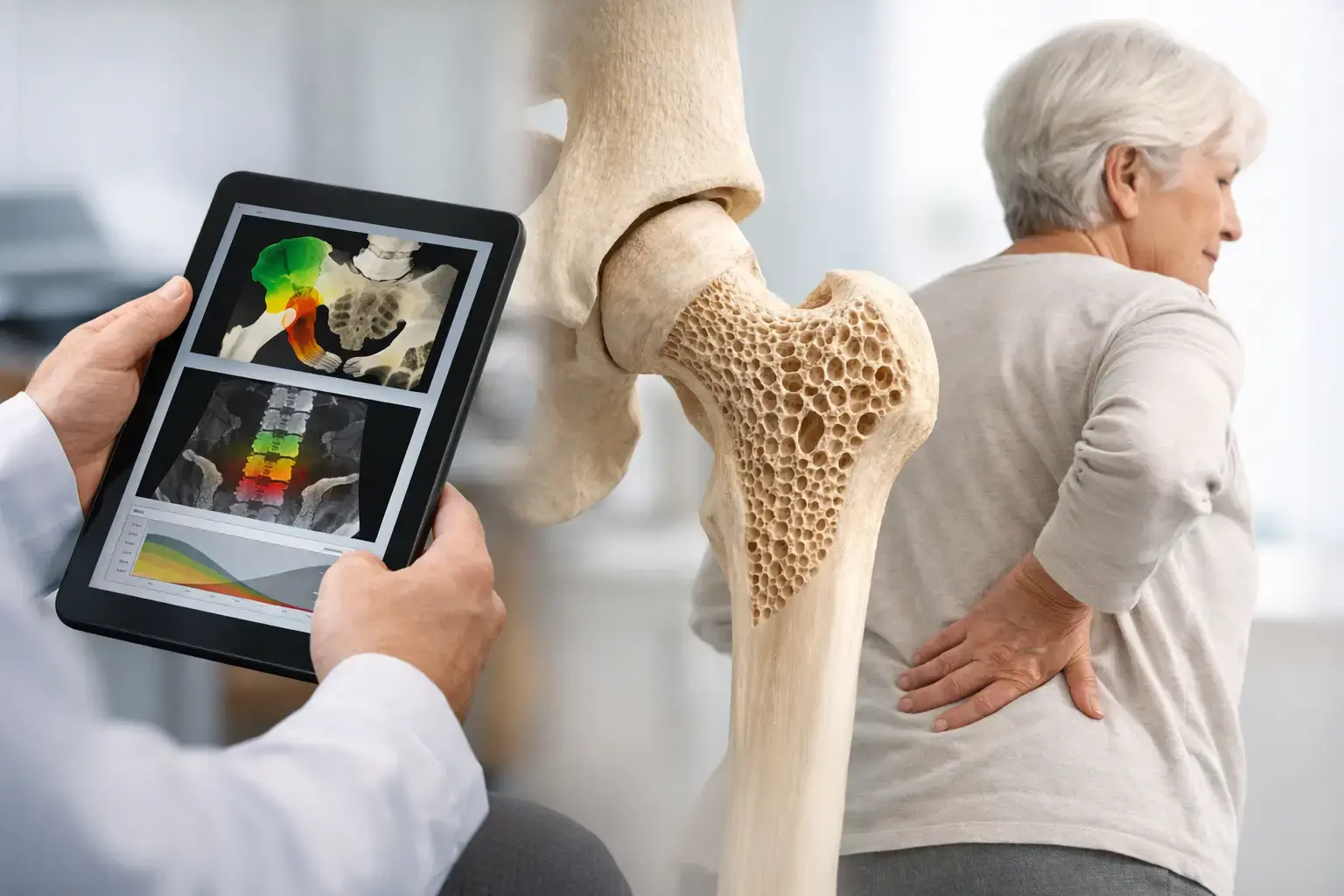
A bone-density result can feel definitive: normal, low bone mass, or osteoporosis. But if you are deciding what that result means for your future fracture risk, the next question is more useful: does density tell the whole story? Fragility Score and FRAX address that gap from different directions. One looks at clinical risk factors and population data. The other adds information reflected in the bone ultrasound signal itself.
They are not competing versions of the same test. They answer related but distinct questions, and understanding the difference can make a bone-health report far more meaningful.
What FRAX estimates
FRAX is a clinical fracture-risk calculator. It estimates the probability of a major osteoporotic fracture and a hip fracture over the next 10 years. The calculation uses factors known to affect fracture risk, including age, sex, height and weight, prior fracture, parental hip fracture, smoking, glucocorticoid use, rheumatoid arthritis, certain causes of secondary osteoporosis, and alcohol intake. Depending on the setting, it can also incorporate bone mineral density at the femoral neck.
That structure makes FRAX useful. Fracture risk is not determined by density alone. A 68-year-old with a previous fragility fracture and a 68-year-old with no fracture history may have the same femoral-neck density but different risk profiles. FRAX gives the clinical context a formal place in the estimate.
It also has boundaries. FRAX is calibrated to populations and country-specific fracture data, not to every detail of one person's health. It does not directly account for fall frequency, dose and duration of every medication exposure, or changes in risk over the next several months. It is a risk model, not a diagnosis and not a complete description of bone strength.
Why type 2 diabetes can complicate a reassuring density result
Type 2 diabetes is a clear example of why density and fracture risk do not always move together. Research has repeatedly found that people with type 2 diabetes can have bone mineral density that is normal or even higher than expected while still experiencing higher fracture risk. The reasons are still being studied, but likely involve changes in bone material properties, diabetes-related complications that affect falls, and other metabolic factors.
FRAX includes a category for secondary osteoporosis, but type 2 diabetes is not a direct input in the standard calculator. As a result, FRAX may underestimate risk in some people with diabetes. This does not make the calculation useless. It means a clinician needs to interpret it alongside the full medical picture rather than treating one percentage as the final answer.
What the Fragility Score adds
The Fragility Score is derived from radiofrequency echographic multispectrometry, or REMS. REMS is a radiation-free ultrasound method that measures bone mineral density at the lumbar spine and proximal femur. It also analyzes the raw ultrasound signals reflected from bone.
Those reflected signals contain patterns associated with skeletal fragility. The Fragility Score is an independent measure derived from those patterns, rather than a restatement of density. In plain terms, density tells you how much mineralized bone is present. The Fragility Score asks whether the ultrasound signal shows features associated with greater fragility.
That distinction matters because two people can have similar density measurements without carrying the same fragility signal. Consider two adults whose hip density falls in the osteopenia range. Density places them in the same broad category, but their Fragility Scores may differ. That difference does not mean one person's bones are simply “good” and the other's are “bad.” It means the scan has identified additional information that density alone does not provide.
REMS combines bone mineral density and the Fragility Score to estimate fracture risk over the next five years. This is a different time horizon and a different approach from FRAX. FRAX relies on clinical variables, with optional femoral-neck density. The REMS estimate weighs density together with ultrasound-derived fragility information.
Fragility Score and FRAX: why the numbers may not agree
A FRAX estimate and a REMS five-year fracture-risk estimate should not be expected to match. They were designed differently, use different inputs, and report risk over different periods. FRAX estimates 10-year probability using clinical factors and, when available, femoral-neck density. REMS estimates five-year risk using density and the independent Fragility Score obtained from the ultrasound signal.
A difference between them is not automatically an error or a reason for alarm. It is often an invitation to ask a better question: what information is each method seeing, and what information is it not seeing?
For example, FRAX may rise because of age, a prior fracture, or long-term glucocorticoid exposure even when density is not severely reduced. A REMS result may show a higher Fragility Score than density alone would suggest. Conversely, a person can have low density while the rest of their clinical profile changes how FRAX estimates 10-year probability.
The most useful interpretation is not to choose a winner. It is to recognize that fracture risk has clinical, densitometric, and fragility-related dimensions. A report that distinguishes them can support a more informed conversation with your physician or care team.
What neither number can tell you by itself
Neither FRAX nor a Fragility Score predicts whether you personally will fracture on a particular day or during a particular activity. Fractures occur through a combination of skeletal fragility and force. A fall, its direction, balance, muscle function, vision, medications, and the environment all influence what happens in the moment.
Neither measure replaces medical evaluation, either. New back pain, a loss of height, a fracture after a low-trauma event, or a major change in health history deserves clinical attention regardless of a calculated risk estimate.
There are also measurement considerations. FRAX depends on accurate clinical history and the correct country model. A Fragility Score depends on a technically sound REMS scan at the measured skeletal sites. Results should be read in context, particularly when someone has had orthopedic hardware, significant spinal changes, or conditions that affect how scans can be interpreted.
When information beyond density is especially useful
If you already have osteopenia or osteoporosis, additional information can help clarify whether density is telling the same story as ultrasound-derived fragility. If you are moving through perimenopause or menopause, it can establish a baseline during a period when bone loss may accelerate before routine screening is commonly offered.
It can also be relevant when density may understate concern, including type 2 diabetes, glucocorticoid exposure, some cancer-treatment histories, and rapid weight loss. In these situations, the value is not a more dramatic label. It is a clearer starting point for discussion and monitoring.
Precision affects that monitoring conversation. REMS has reported intra-operator precision error below 0.5%, compared with commonly reported DXA spine precision errors of roughly 0.9% to 1.9%. Lower measurement error matters because it improves the ability to distinguish a real change over time from normal test variability. It does not make every short-term change clinically meaningful, but it gives follow-up data a firmer technical foundation.
A clearer way to read your bone-health data
If you have a FRAX result, ask which clinical factors drove it and whether femoral-neck density was included. If you have a REMS report, look at the three distinct outputs: bone mineral density, Fragility Score, and estimated five-year fracture risk. Each contributes a different piece of the picture.
The goal is not to collect more numbers for their own sake. It is to make an invisible process more understandable before a fracture forces the conversation. Your bones deserve the same informed attention you already give blood pressure, glucose, and cholesterol: not fear, just useful information early enough to matter.