
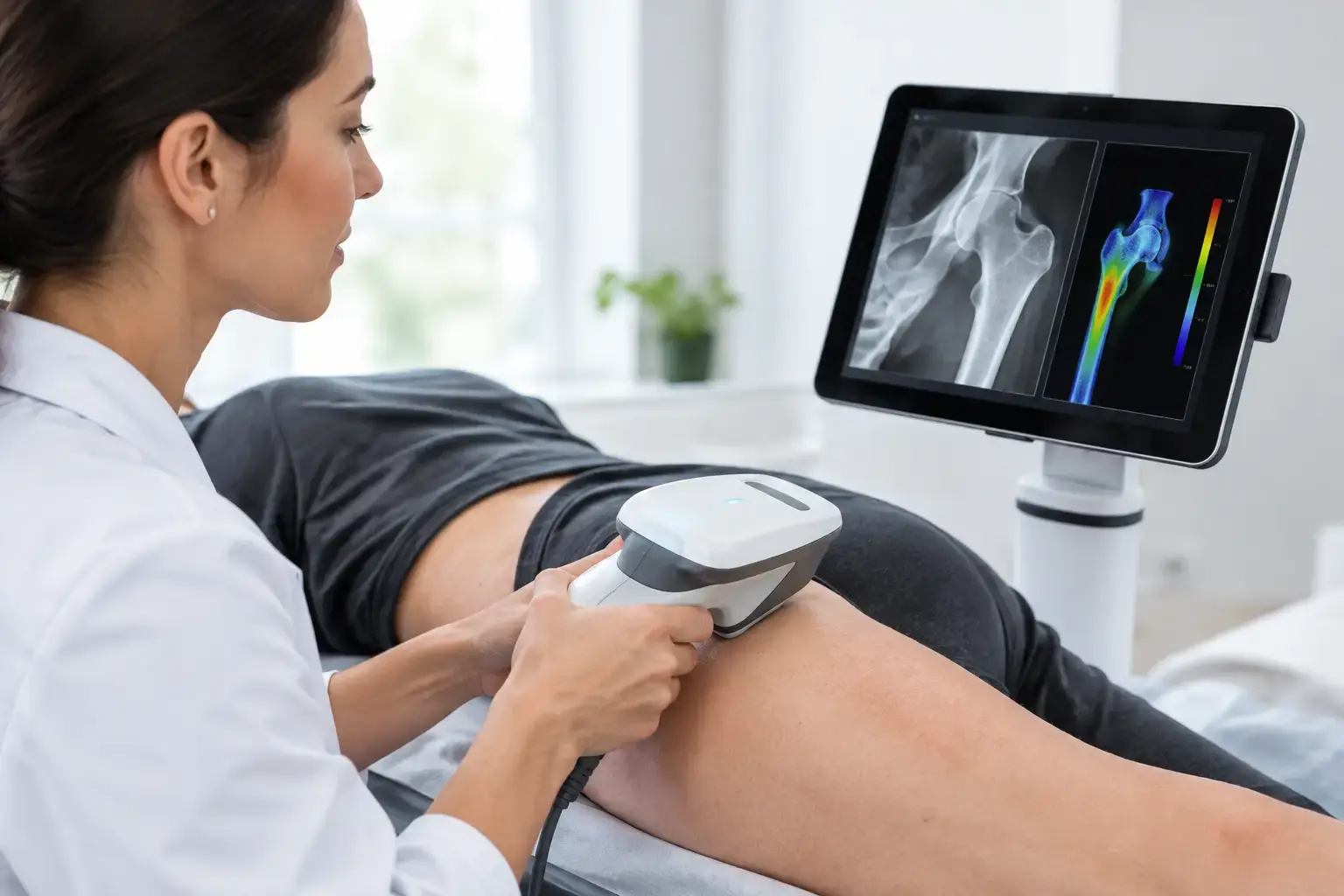
A patient with type 2 diabetes can have a normal, even above-average, bone density result and still carry elevated fracture risk. That is the information gap this mobile REMS provider guide addresses: what to do when bone mineral density is useful, but does not fully explain the clinical picture.
For many practices, bone health enters the conversation only after a low-trauma fracture, a concerning DXA result, or a medication decision. Yet skeletal changes are often silent for years. The opportunity is not to replace clinical judgment or established pathways. It is to give patients and their care teams more meaningful information before consequences force the conversation.
What REMS adds to bone density
Bone mineral density, or BMD, remains central to skeletal assessment. It estimates how much mineralized bone is present, generally at the lumbar spine and proximal femur. That information matters for diagnosis, risk stratification, and longitudinal care.
But density is not the entire biology of fragility. Two people can have similar BMD values and different fracture outcomes. Bone strength is influenced by more than mineral quantity, and conventional density measurement does not directly capture every signal associated with skeletal fragility.
REMS, short for Radiofrequency Echographic Multi Spectrometry, uses radiation-free ultrasound to measure BMD at the lumbar spine and proximal femur. It also analyzes the raw ultrasound signals reflected from bone to derive an independent Fragility Score. The system then weighs density and Fragility Score together to estimate five-year fracture risk.
That gives a patient three distinct pieces of information: how much mineralized bone is present, whether the reflected signal shows signs associated with greater fragility, and what those measures together indicate about estimated near-term fracture risk.
The distinction is practical. A patient whose density and Fragility Score point in the same direction has a clearer story. A patient with relatively reassuring density but a higher Fragility Score has a more complicated story worth placing alongside age, fracture history, medication exposure, metabolic disease, falls risk, and the rest of the clinical record.
REMS does not measure bone flexibility, failure load, or microarchitecture. It provides a density measurement plus a separate ultrasound-derived Fragility Score, which adds information beyond density alone. Precision about that boundary matters when discussing results with patients.
Why density can miss risk in type 2 diabetes
Type 2 diabetes is one of the clearest examples of why a density-only conversation can be incomplete. Research has repeatedly shown that people with type 2 diabetes may have normal or higher BMD while still experiencing increased fracture risk. The mechanisms are not reduced to one finding, but may include changes in bone material properties related to chronic hyperglycemia, along with neuropathy, vision changes, falls, and other factors that affect fracture risk.
For a clinician, the key point is straightforward: a normal density result is not always the same as a normal fracture-risk story.
The same need for context can arise with long-term glucocorticoid exposure, cancer-treatment history, rapid weight loss, and medications or conditions that may affect bone turnover or falls risk. REMS cannot settle every uncertainty in those cases. It can, however, add a second biological signal to the assessment rather than asking density to carry more meaning than it contains.
For patients, this can be easier to understand than a discussion limited to T-scores. They often already grasp the basic question: “How much bone do I have?” The Fragility Score introduces the next question: “What does the signal from that bone suggest about fragility?”
When a mobile REMS assessment fits a practice
A mobile model is most useful when access is the limiting factor. A practice may want objective skeletal data without purchasing, housing, staffing, or scheduling a dedicated imaging system. It can also make assessment more practical for employer groups, community programs, concierge practices, and clinics serving patients who would otherwise delay testing.
MobileREMS by Longevia brings Echolight REMS technology to provider partnerships in Western Washington and the Phoenix area. For a participating practice, the value is not simply convenience. It is the ability to bring a radiation-free assessment into an existing care relationship, where the result can be interpreted with the patient’s history and current decisions in view.
The best fit is usually a practice that has already identified a meaningful question. That question might be whether a patient entering menopause would benefit from a baseline, whether an osteopenia result tells the full story, or whether a patient considering bone-related treatment has enough baseline information to follow change over time.
REMS is also relevant for prevention-focused patients who monitor cardiovascular markers, glucose, fitness, and body composition but have little visibility into their skeleton. Peak bone mass is largely established by early adulthood, genetics strongly influences the ceiling, and bone loss may begin well before standard screening discussions. A baseline does not predict every future outcome. It does turn an invisible system into something measurable.
The operational questions providers should ask
A useful mobile REMS program begins with clinical purpose, not equipment. Before offering assessments, clarify which patients may benefit from information beyond BMD and how findings will enter the chart and follow-up conversation.
Define what the report will answer
The report should be positioned as a source of objective information, not a standalone diagnosis or treatment plan. Providers can use it to discuss BMD, Fragility Score, and estimated five-year fracture risk alongside established clinical variables.
This framing is especially important for patients who arrive expecting a single pass-fail number. A T-score can be valuable, but it is not a complete description of skeletal fragility. The REMS report creates room for a more accurate conversation without overstating what any one test can determine.
Establish a follow-up pathway
Patients need to know who will review the report, how results will be documented, and how questions will be handled. In some settings, the REMS provider performs the assessment and the referring clinician interprets it in the context of the full medical record. In others, the service is integrated more directly into the practice workflow.
Either model can work. The essential issue is continuity. A scan is most useful when the numbers lead to an informed clinical conversation rather than becoming another isolated data point in a patient portal.
Consider monitoring with precision in mind
One practical advantage of REMS is its reported intra-operator precision error below 0.5%, compared with the 0.9% to 1.9% range commonly reported for DXA at the spine. Low measurement error matters because small changes are difficult to interpret when the instrument itself introduces substantial variation.
It does not mean every patient needs frequent repeat assessment. Timing depends on the clinical question, the expected rate of change, and the care setting. It does mean that when reassessment is clinically relevant, REMS is designed to detect change with a high degree of measurement precision. That capability has particular relevance in research settings where bone changes can occur quickly, including spaceflight-related skeletal-loss research.
How to explain REMS without overselling it
The most effective patient explanation is direct: density tells us how much mineralized bone is present. REMS also analyzes reflected ultrasound signals for an independent Fragility Score, then combines those data to estimate five-year fracture risk.
Avoid presenting the Fragility Score as a replacement for BMD. It is a complementary measure. Avoid implying that a reassuring result eliminates fracture risk, or that a concerning result predicts a fracture. Risk estimates are probabilities, not certainties, and they gain meaning when interpreted with the individual’s clinical context.
This language is particularly helpful for patients with osteopenia or osteoporosis, who may have already absorbed a frightening label. More information should create agency, not alarm. A clearer baseline can support better questions about monitoring, treatment discussions, nutrition, mechanical loading, medication exposures, and fall-related risks without turning the scan itself into a verdict.
A better starting point for bone conversations
The point of adding REMS is not to make bone health more complicated for patients. It is to stop pretending that one number tells the whole story.
When a patient can see density, Fragility Score, and estimated five-year fracture risk together, the conversation can move beyond “Is my bone density low?” to a more useful question: “What does the available evidence say about my bones now, and what information would matter most as we follow them over time?”