
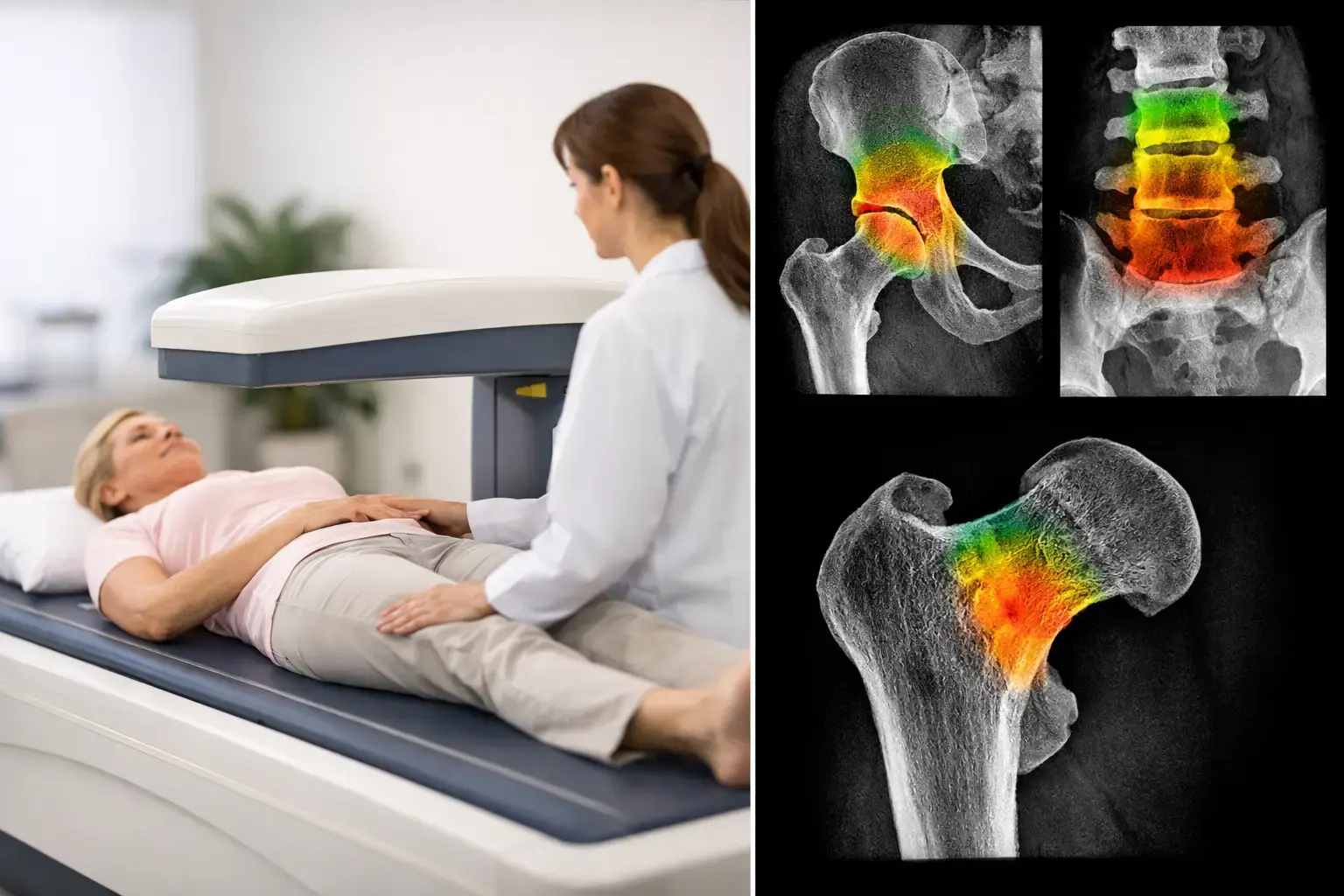
A bone-density result can be reassuring, concerning, or somewhere in between. But if you are looking into Phoenix osteoporosis testing, the more useful question is not only how much mineralized bone you have. It is whether the information you receive can also help explain skeletal fragility and your likely fracture risk.
That distinction matters because fractures are not caused by a T-score alone. Bone mineral density is one meaningful part of the picture, but two people can have similar density measurements and carry different levels of fragility. One may have a lower fracture-risk estimate than expected from density alone; the other may have a higher one.
For decades, standard bone assessment has centered on bone mineral density, most often measured with DXA. Density remains clinically valuable. It helps classify osteoporosis and osteopenia, establishes a baseline, and can be followed over time. The limitation is not that density is wrong. It is that density is incomplete.
What Phoenix osteoporosis testing should tell you
A useful bone-health assessment answers more than one question. First: how much mineralized bone is present at clinically relevant sites, including the lumbar spine and proximal femur? Second: is the bone showing signal patterns associated with greater fragility? Third: when those findings are considered together, what do they suggest about fracture risk?
Those questions are especially relevant when the usual screening timeline does not match your situation. Bone loss can accelerate during the menopause transition, while routine population screening often begins later. Long-term glucocorticoid use, rapid weight loss, cancer-treatment history, and some metabolic conditions can also change the conversation.
Type 2 diabetes is one of the clearest examples of why density cannot stand alone. People with type 2 diabetes may have bone mineral density that appears normal or even elevated, yet their fracture risk can still be higher. Several mechanisms are being studied and recognized clinically, including changes in bone material quality related to chronic hyperglycemia, as well as factors such as falls and diabetes complications. A normal density result does not automatically mean normal skeletal risk.
That is not a reason to distrust density. It is a reason to ask for information that can put density in context.
Density measures quantity, not the whole fragility story
Bone is living tissue. It responds to hormonal changes, illness, nutrition, mechanical loading, medication exposure, and aging. Bone mineral density estimates the amount of mineralized bone in a given area. That number is useful because less mineralized bone is generally associated with greater fracture risk.
But the relationship is not one-to-one. Density does not independently describe every structural signal associated with fragility. This is why a person can have a density result that does not fully match their clinical history, risk factors, or eventual fracture risk.
Imagine two people whose density measurements fall into the same range. If one person’s bone tissue reflects ultrasound signals associated with greater fragility and the other’s does not, treating those reports as identical leaves out meaningful information. The density number has not changed. What it can tell you on its own has reached its limit.
This distinction can be useful whether you have never had a bone assessment or already carry a diagnosis of osteopenia or osteoporosis. If you know your T-score, you already have one important data point. A fuller assessment can help you understand whether density and fragility are telling a consistent story or a more complicated one.
How REMS adds information beyond bone density
REMS, short for Radiofrequency Echographic Multi Spectrometry, uses radiation-free ultrasound to measure bone mineral density at the lumbar spine and proximal femur. It also analyzes raw ultrasound signals reflected from the bone to derive an independent Fragility Score.
The Fragility Score is not another name for density, and it is not a direct measurement of flexibility, microarchitecture, failure load, or every aspect of bone quality. It is a distinct measure derived from the reflected ultrasound signal and reflects signs associated with skeletal fragility that density alone does not capture.
REMS then considers density and the Fragility Score together to estimate five-year fracture risk. The result is a report built around three understandable measures: bone mineral density, Fragility Score, and estimated five-year fracture risk.
That combination can make the invisible more understandable. Rather than leaving with only a classification or a single number, you have information that can support a more informed conversation with your physician or other qualified clinician.
For someone in perimenopause, the value may be an earlier baseline and a way to observe change through a period when bone loss can accelerate. For someone with known osteopenia, the value may be understanding whether fragility information reinforces or complicates the density result. For someone considering an osteoporosis medication, preparing for orthopedic care, or monitoring a period of rapid weight change, objective baseline information can clarify the discussion without dictating a treatment decision.
Why precision changes the value of follow-up
A test is most useful over time when it can distinguish a meaningful biological change from measurement noise. This is where precision matters.
REMS is FDA-cleared and radiation-free. Its reported intra-operator precision error is below 0.5%, compared with the approximately 0.9% to 1.9% typically reported for DXA at the spine. That difference is not merely technical language for a report. Lower measurement error can make it possible to re-measure over months rather than waiting years, with greater confidence that a detected difference reflects a real change rather than normal instrument variation.
The practical meaning depends on your reason for testing. A one-time assessment may be most useful for establishing a baseline or bringing better data into a clinical decision. Repeat assessment may be more relevant when bone health is changing quickly or when you and your clinician are following a specific concern. The appropriate timing and interpretation belong in the context of your medical history, medications, and risk factors.
Precision also matters because bone health rarely announces itself. There is no routine sensation that tells you mineralized bone is declining or that fragility-associated changes are developing. Often, the first unmistakable event is a fracture. Earlier information cannot eliminate every risk, but it can make the conversation possible before consequences force it.
Who may benefit from a more complete bone assessment?
The answer is not limited to age or a diagnosis. It depends on what you need to know.
If you are prevention-focused, consider how much data you may already track: blood pressure, glucose, cholesterol, body composition, sleep, strength, and cardiovascular fitness. Yet many people reach midlife without knowing their bone-density baseline. Peak bone mass is largely built by the late twenties, genetics strongly shapes the ceiling, and decline commonly begins from midlife onward. Bones deserve the same informed attention given to other long-term health measures.
If you have type 2 diabetes, a normal density score may be less reassuring than it sounds when considered by itself. If you are managing menopause, a history of steroid exposure, a cancer-treatment history, or substantial weight loss, the question may be whether standard density testing captures enough of your situation. If you already have osteoporosis, the question may be gentler but no less valid: what else can the report tell you about fragility and risk?
In Phoenix, osteoporosis testing with REMS offers a radiation-free way to obtain this broader set of measurements. MobileREMS provides reports designed to be understandable to you and useful in conversations with your healthcare team.
A bone scan should not create fear or replace clinical judgment. It should give you a clearer view of what is already there: how much bone you have, whether ultrasound-derived fragility information adds concern or reassurance, and what the two measures together suggest about fracture risk. That is useful information to have while you still have time to use it.