
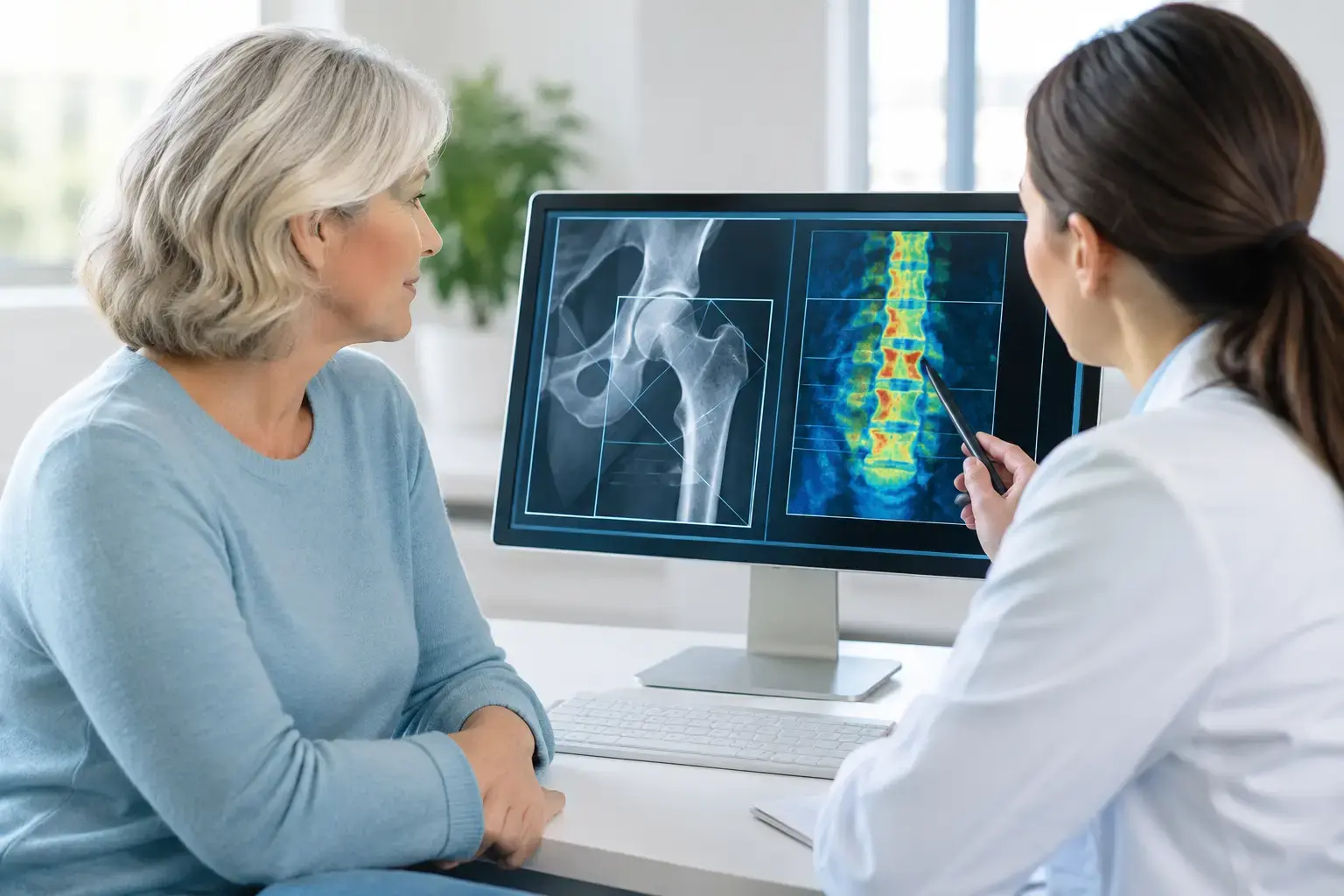
A normal bone-density result can be reassuring, but it is not always the whole answer. The question behind risk factors versus bone density is whether the amount of mineralized bone you have tells the same story as your likelihood of fracture. Often, it does not.
That gap matters most when a person has a risk factor that can affect skeletal strength without producing an obviously low density score. Type 2 diabetes is the clearest example: bone mineral density may be normal or even higher than expected, while fracture risk is still elevated. If you only look at density, that result can appear more reassuring than the full clinical picture warrants.
Bone density answers one essential question
Bone mineral density, commonly reported as a T-score or Z-score, estimates how much mineralized bone is present at a measured site. It is a meaningful measure. Lower density is associated with a higher fracture risk, which is why bone density has been central to osteoporosis assessment for decades.
But density is an amount, not a complete description of fragility. Think of two people whose scans show the same bone mineral density at the hip. One may have no major skeletal risk factors and no signs suggesting greater fragility. The other may have type 2 diabetes, a history of long-term glucocorticoid use, or rapid weight loss. Their density number may match, but their fracture risk may not.
This is not a flaw in the concept of density. It is a limit of what one measurement is designed to describe. A density score cannot independently account for every biological process, health condition, medication exposure, or structural signal associated with fracture risk.
Risk factors versus bone density: not competing measures
It can be tempting to frame risk factors and bone density as competing explanations. In practice, they answer different questions.
Bone density tells you how much mineralized bone is present. Risk factors add context about circumstances known to influence bone loss, fracture likelihood, or both. Age, prior fragility fracture, family history, menopause transition, smoking, low body weight, certain medications, and conditions affecting hormone balance, nutrient absorption, inflammation, or mobility can all matter.
Some risk factors tend to lower density over time. Others can increase fracture risk in ways that density does not fully reflect. That distinction is why a clinical conversation should not end with, “My T-score is fine,” or begin and end with, “I have a risk factor.” The useful question is how the information fits together.
A prior low-trauma fracture, for example, carries weight because it is evidence of what the skeleton has already experienced. Long-term glucocorticoid exposure matters because these medications can alter bone remodeling and increase fracture risk, sometimes before density changes fully capture the effect. Cancer treatment histories deserve careful, individualized context because treatment effects vary widely by therapy, timing, hormonal changes, and overall health.
Risk factors do not guarantee a fracture. They identify reasons to look beyond a single number.
Why type 2 diabetes can create a false-normal picture
Type 2 diabetes deserves special attention because it challenges the assumption that normal density means normal skeletal risk. Research has repeatedly found higher fracture risk in people with type 2 diabetes despite bone mineral density that may be normal or elevated.
One proposed mechanism involves chronic hyperglycemia and advanced glycation end products, which can accumulate in collagen-containing tissues, including bone. Diabetes may also affect bone remodeling, fall risk, vision, neuropathy, kidney function, and medication exposures. None of those factors is fully summarized by a density score alone.
The point is not that everyone with diabetes has the same bone risk. It is that density can be incomplete in a predictable direction for this population. A normal result deserves interpretation alongside the condition itself and other available bone information.
Fracture risk is the outcome people actually care about
Most people do not seek bone information because they want a better spreadsheet. They want to understand whether their bones are likely to hold up through daily life, aging, a medication decision, a period of weight change, or recovery from illness.
Fracture risk is influenced by more than bone density. Falls matter. So do age, previous fractures, medications, health conditions, and signals of skeletal fragility. Risk calculators can combine several of these inputs, but any estimate depends on the information included in the model.
That is why two people with the same T-score can reasonably receive different assessments of concern. The density measurement is real. It simply does not erase the rest of the story.
For someone in perimenopause or menopause, this may mean establishing a baseline while hormonal changes can accelerate bone loss. For someone already diagnosed with osteopenia or osteoporosis, it may mean asking whether density alone explains their risk or whether there is more to understand. For a prevention-focused person who tracks glucose, lipids, body composition, and training data, it may reveal a blind spot: peak bone mass is largely built by early adulthood, genetics strongly shapes the ceiling, and gradual decline can begin long before bone health becomes a routine topic.
What REMS adds beyond density
Radiofrequency Echographic Multi Spectrometry, or REMS, measures bone mineral density at the lumbar spine and proximal femur using radiation-free ultrasound. It also analyzes raw ultrasound signals reflected from bone to derive an independent Fragility Score.
That distinction is central. The Fragility Score is not another name for density, and it is not a direct measurement of bone flexibility, microarchitecture, or failure load. It reflects ultrasound-signal characteristics associated with skeletal fragility that density alone does not capture.
REMS then considers bone mineral density and the independent Fragility Score together to estimate five-year fracture risk. The result is a more layered conversation: How much mineralized bone is present? Is the reflected signal showing signs associated with greater fragility? What do those measures mean together for estimated fracture risk?
For a person whose density appears reassuring but whose clinical context is more complicated, that added information can be especially meaningful. It does not replace medical history, clinical judgment, or discussion with a physician. It gives that discussion another objective data point.
MobileREMS provides those three results in a report designed to be understandable and useful in a medical conversation: density, Fragility Score, and estimated five-year fracture risk.
Monitoring matters when change is the question
A baseline is valuable because bone health is not static. Menopause, medication changes, rapid weight loss, chronic illness, and changes in activity or nutrition can all affect the trajectory. When the question is whether bone measures are changing, precision matters as much as the headline number.
REMS has an intra-operator precision error below 0.5%, compared with the roughly 0.9% to 1.9% typically reported for DXA at the spine. That is not merely a technical advantage. A lower measurement error can make it easier to distinguish a meaningful change from ordinary measurement variation and can support re-measurement over months rather than waiting years.
Still, no scan should be treated as a verdict in isolation. Measurements become more useful when they are compared consistently over time and interpreted alongside health history, symptoms, medications, and other clinical information.
A fuller question leads to a clearer conversation
The most useful shift is simple: move from “Is my density normal?” to “What does my density tell me, what does it miss, and how does it fit with my risk factors?”
That question creates room for nuance without creating fear. A risk factor is not destiny. A favorable density score is not a lifetime guarantee. Together, they are pieces of evidence that can make the invisible biology of bone more understandable before a fracture is forced to do the explaining.