
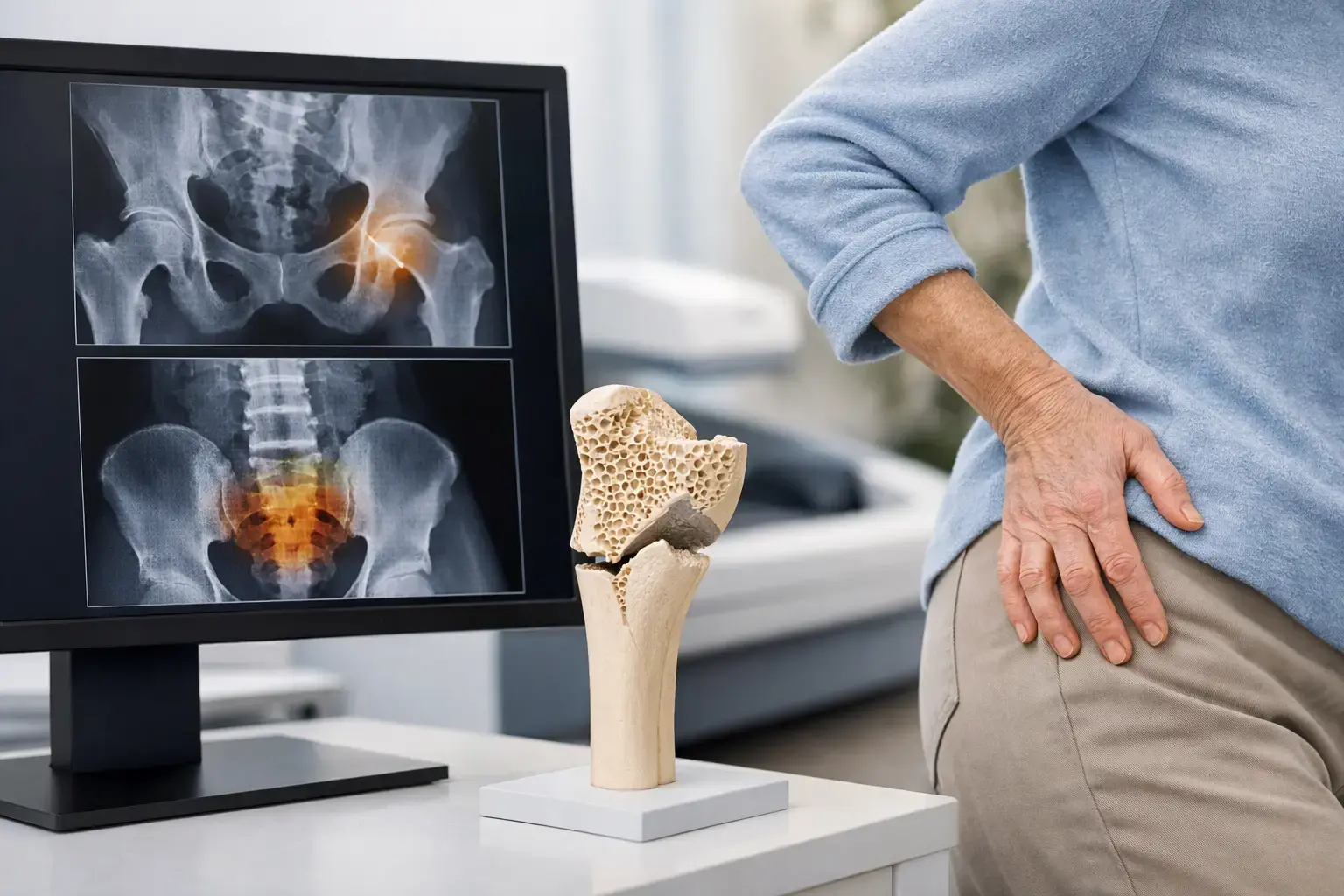
If you have been told you have osteopenia, you may be wondering why fractures happen with osteopenia when the word itself can sound like a mild version of osteoporosis. The answer is not that every person with osteopenia is headed toward a fracture. It is that fracture risk is shaped by more than the amount of mineralized bone shown on a density scan.
Osteopenia is a density category, not a complete description of bone strength or a forecast of your future. It usually refers to a T-score between -1.0 and -2.5 on a bone mineral density test. That number matters. But it cannot, by itself, explain why two people with similar density can have very different experiences with fracture.
Why Fractures Happen With Osteopenia
A fracture happens when the force placed on a bone exceeds what that bone can withstand. A fall can create that force, but falls are only one part of the equation. The other part is skeletal fragility: whether the bone is showing characteristics associated with a greater likelihood of fracture.
With osteopenia, there is less mineralized bone than in the reference range for a young healthy adult. Less mineralized bone can reduce the margin between ordinary daily forces and the force required to cause a fracture. A stumble, a fall from standing height, or sometimes a movement that would not have caused concern years earlier may be enough when several risk factors converge.
Still, density does not operate alone. Age, a previous fragility fracture, certain medications, menopause-related estrogen loss, low body weight, smoking, alcohol exposure, conditions that affect hormone or nutrient metabolism, and fall risk all influence the picture. The same is true for long-term glucocorticoid use and some cancer treatments. Osteopenia can be one meaningful piece of the risk profile without being the whole explanation.
Bone Density Measures Quantity, Not the Full Fragility Story
Bone mineral density answers a useful question: how much mineralized bone is present at a measured site, commonly the lumbar spine and hip. It is a validated and central part of fracture-risk assessment. But it is not a direct measure of every feature associated with fragile bone.
Think of two people who receive the same osteopenia-range density result. One has no prior fracture, no major secondary risk factors, and a low likelihood of falling. The other has type 2 diabetes, has lost height, and recently sustained a wrist fracture after a low-impact fall. Their density may look similar, yet their fracture risk may not.
Type 2 diabetes makes the limitation especially visible. People with type 2 diabetes may have bone density that appears normal or even higher than expected, while fracture risk remains elevated. The mechanisms are still being studied, but diabetes-related changes in bone material and quality, along with complications that can affect balance and vision, may contribute. A reassuring density number does not automatically settle the fracture-risk question.
This is why osteopenia should not be dismissed as "just a little bone loss," nor treated as a prediction that a fracture must occur. It is a signal to place density in a fuller clinical context.
Fracture Risk Is a Combination of Bone and Circumstance
The site of the fracture matters, too. Hip and spine fractures often receive the most attention because of their potential consequences, but wrist, upper arm, pelvis, and rib fractures can also be important clues to underlying skeletal fragility. A low-trauma fracture is not simply bad luck to ignore. It is information that deserves a closer look.
The force involved matters as well. A high-energy event, such as a vehicle collision or a major sports injury, can fracture healthy bone. Fragility fractures are different: they occur with force that would not ordinarily fracture a healthy bone, often from a fall at standing height or less. The distinction helps clinicians separate an injury caused primarily by extreme force from one that may reveal increased skeletal vulnerability.
Risk also changes over time. Bone loss may accelerate around menopause. Rapid weight loss, reduced mobility, illness, medication changes, and aging can all alter the factors surrounding a density score. A result from several years ago may still be useful history, but it may not describe your current risk as completely as you need it to.
What an Osteopenia T-Score Cannot Tell You Alone
A T-score places your bone density on a standardized scale. It does not independently tell you whether the reflected signals from your bone show features associated with greater fragility. It does not account for every clinical factor that affects fracture likelihood. And it cannot tell you that a fracture is certain or impossible.
That uncertainty is frustrating when you are making decisions about bone health. You may want to know whether your osteopenia result represents a stable baseline, a changing pattern, or a level of risk that deserves more attention. Density is still part of that answer. The problem is expecting one number to carry information it was never designed to provide.
A more useful conversation asks three separate questions: How much mineralized bone is present? Is there additional evidence associated with skeletal fragility? And when those findings are considered together, what is the estimated risk of fracture over the next several years?
What REMS Adds Beyond Density
REMS, or radiofrequency echographic multi-spectrometry, measures bone mineral density at the lumbar spine and proximal femur using radiation-free ultrasound. It also analyzes raw ultrasound signals reflected from bone to derive an independent Fragility Score.
The Fragility Score is not another name for density. It reflects signal characteristics associated with fragility that density alone does not capture. REMS then weighs density and Fragility Score together to estimate five-year fracture risk. This creates a more complete set of information: density, an independent measure related to fragility, and an estimate of what the combination may mean for fracture risk.
That distinction matters for someone with osteopenia because a density category can conceal meaningful differences between individuals. One person may have an osteopenia-range T-score with a lower fragility signal and lower estimated risk. Another may have a similar T-score with a higher Fragility Score and a different risk conversation to have with their clinician.
REMS does not make fractures predictable with certainty, and it does not replace clinical judgment. It does provide information beyond density without claiming to directly measure every aspect of bone biology or the exact force a bone can tolerate.
Monitoring Matters When Bone Health Is Changing
A single scan is a snapshot. Repeated measurements can show whether a pattern appears stable or is changing, provided the method is precise enough to distinguish a meaningful change from ordinary measurement variation.
MobileREMS uses FDA-cleared, radiation-free Echolight REMS technology, with an intra-operator precision error below 0.5%. Low measurement error is not merely a technical detail. It can make shorter-interval monitoring more informative, particularly when someone is tracking bone health through menopause, weight change, treatment decisions, or another period when risk factors may be shifting.
The report is also designed to be usable in a medical conversation. Rather than arriving with only a T-score, you can bring density, Fragility Score, and estimated five-year fracture risk to the clinician who knows your history, medications, and broader health picture.
The Useful Question After an Osteopenia Result
The next question is not simply, "Do I have osteopenia?" It is, "What does this result mean in the context of my bones and my life right now?" That question leaves room for the factors a density category cannot settle by itself.
A fracture is often the first event that makes bone health visible. It does not have to be. Better bone information gives you and your care team a clearer starting point before consequences are forced to begin the conversation.