
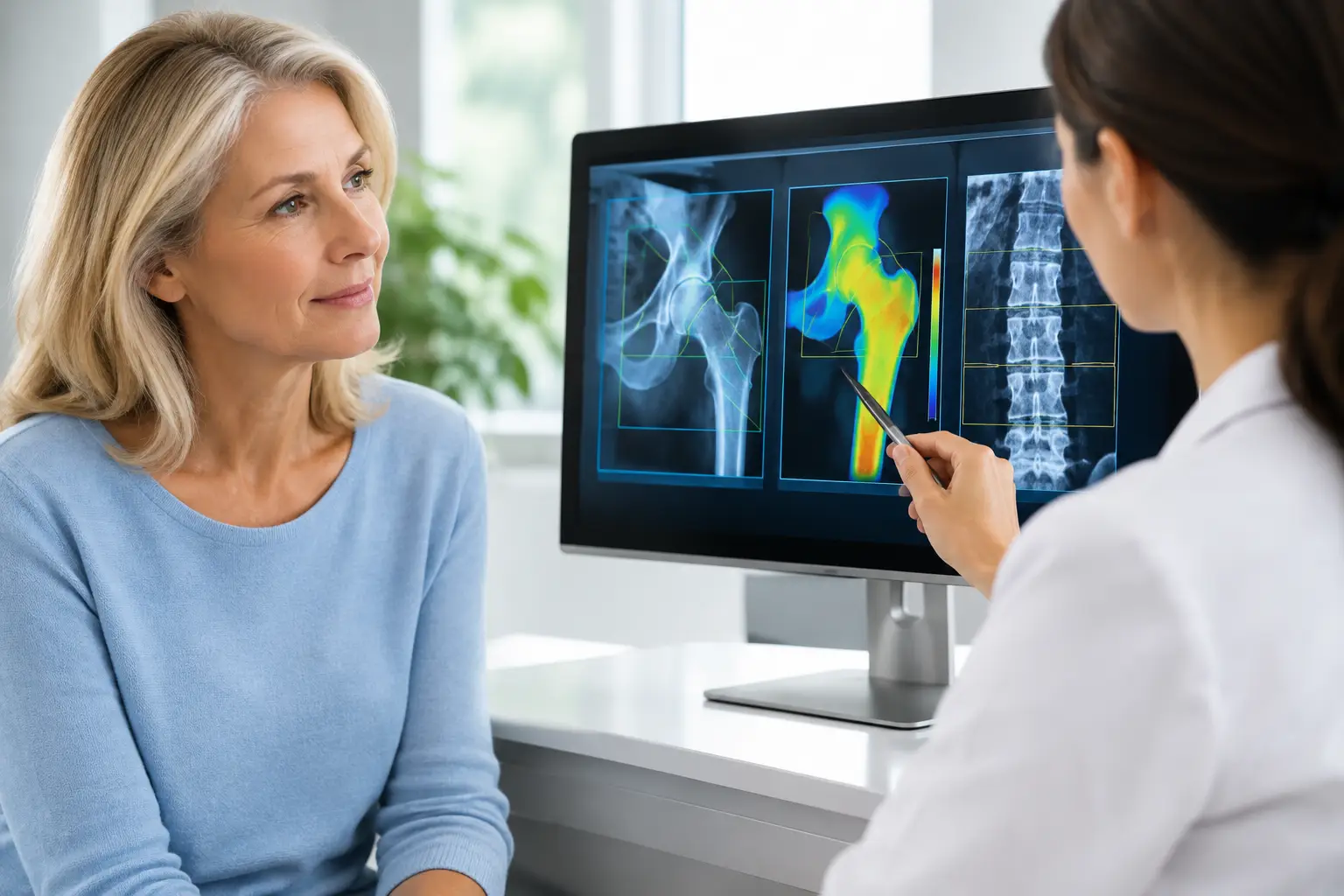
A bone density result can be reassuring, confusing, or both. If you have been told your density is normal, low, or in the osteopenia range, the question underneath is often more personal: does this number tell me how likely my bones are to hold up? That is the central issue in density versus fragility.
Bone mineral density is useful information. It measures how much mineralized bone is present at a tested site, usually the lumbar spine and hip. But density is not a complete description of skeletal fragility or fracture risk. Two people can have similar density results and still carry meaningfully different risk.
That is not a flaw in the idea of measuring density. It is a limit of asking one measurement to answer every question. Your bones are living tissue, and the information relevant to fracture risk is broader than mineral quantity alone.
What bone density tells you
Bone mineral density, often reported with a T-score, compares the amount of mineral in your bone with a reference population. Lower density is associated with higher fracture risk, which is why density has been central to osteoporosis assessment for decades.
It also gives you a baseline. A baseline matters because bone can change during menopause, with aging, during periods of rapid weight loss, after certain cancer treatments, with long-term glucocorticoid use, and in other circumstances that affect bone metabolism. Mechanical loading also stimulates bone adaptation, while hormones, nutrition, illness, medications, and genetics all influence the balance between bone formation and bone resorption.
Still, density answers one precise question: how much mineralized bone is present? It does not independently identify every structural signal associated with fragility.
A useful way to picture this is to imagine two people leaving an assessment with the same density score. One may have a lower indication of fragility in the bone signal. The other may show stronger signs associated with fragility. The density number alone makes them look alike. Their fuller bone-health picture may not be alike at all.
Density versus fragility: why the distinction matters
Fragility is the tendency of bone to fracture under forces that would not ordinarily fracture healthy bone. It is the clinical consequence people want to understand, but it is not interchangeable with low density.
This distinction is particularly visible in type 2 diabetes. People with type 2 diabetes can have bone density that reads as normal or even higher than expected while their fracture risk remains elevated. The Rotterdam Study and other population research have helped establish this apparent paradox. Diabetes-related changes in bone tissue and the broader effects of falls risk, complications, and medications can contribute to risk that density does not fully explain.
That does not mean density is irrelevant in diabetes. It means a normal density result should not automatically end the conversation about skeletal health.
The same principle can matter in other situations where the density number may not tell the whole story: a prior low-trauma fracture, long-term steroid exposure, major hormonal change, rapid weight loss, or a history of treatment that affects bone. Context matters because fracture risk is never a single-number problem.
Fragility is not the same as “brittleness”
It helps to be specific about what this language means. In everyday conversation, people may call bone “brittle.” Clinically, skeletal fragility refers to the overall tendency toward fracture, informed by multiple biological and clinical factors.
No single test directly measures every property that determines whether a bone will fail under force. Bone biology includes mineralization, tissue organization, turnover, geometry, loading history, and factors outside the skeleton, including balance and fall exposure. Good assessment is not about claiming that one number sees everything. It is about using each measurement for what it can genuinely tell you.
What REMS adds beyond density
Radiofrequency Echographic Multi Spectrometry, or REMS, uses radiation-free ultrasound to measure bone mineral density at the lumbar spine and proximal femur. It also analyzes the raw ultrasound signals reflected from bone to derive an independent Fragility Score.
The distinction is important. Density is the measurement of mineralized bone present. The Fragility Score reflects ultrasound-signal characteristics associated with skeletal fragility that density alone does not capture. REMS then weighs density and the Fragility Score together to estimate five-year fracture risk.
That gives you three related, but distinct, pieces of information:
- bone mineral density
- an independent Fragility Score
- estimated five-year fracture risk
These values are not competing answers. They are different views of the same clinical question. How much bone is present? Is there a greater signal of fragility beyond density? What does the combination suggest about near-term fracture risk?
For someone with osteopenia or osteoporosis, this can make a familiar density result more interpretable. A T-score remains meaningful, but it no longer has to carry the entire burden of explaining risk. For someone focused on prevention, it can provide a more complete baseline before a fracture, a dramatic density decline, or a new diagnosis forces attention to bone health.
Why precision changes the monitoring conversation
A measurement is most valuable when you can tell whether a change is likely to be real. Every assessment technology has some degree of measurement variation. If that variation is large, small changes between scans may be difficult to distinguish from ordinary instrument or operator noise.
REMS has an intra-operator precision error below 0.5%, compared with the 0.9% to 1.9% range commonly reported for DXA at the spine. That is not merely a technical advantage on a specification sheet. Greater precision can make repeat measurement more informative over shorter intervals, because a change on the report is less likely to be explained by measurement noise alone.
This is relevant when bone change may occur more quickly than usual. Menopause is one example. Rapid weight loss is another. It can also matter when someone is establishing a baseline around a medication decision or tracking a known skeletal concern with their clinician.
Precision does not make every short-term change clinically significant, and repeat testing still needs a reason and context. But it improves the quality of the question you can ask over time: is my bone measurement actually changing, or are we mostly seeing the limits of the measurement?
A clearer conversation with your clinician
Bone information is most useful when it can travel with you into clinical decisions. A REMS report provides density, Fragility Score, and estimated five-year fracture risk in a form you can review and share with your physician or other qualified clinician.
That does not replace medical judgment. Fracture risk also depends on personal history, prior fractures, medications, age, health conditions, family history, and fall-related factors. It does give the conversation more substance than a density number alone.
For example, a person considering osteoporosis medication may want an objective baseline that includes more than density. Someone with type 2 diabetes may want to understand whether an apparently reassuring density result is the whole picture. Someone entering menopause may simply want to know what their bones look like before change becomes harder to see and harder to discuss.
The goal is information before consequences
Most people can name a cholesterol value, a glucose result, or a blood-pressure reading. Far fewer know their bone density, and fewer still have information about fragility beyond density. Yet a fracture is often the event that finally brings bone health into focus.
That sequence is backward. A fracture can be a serious outcome, but it should not be the first time your skeleton becomes visible to you.
Density remains an essential part of bone assessment. The more useful question is whether density is the only information you have. When you can see mineralized bone, signals associated with fragility, and an estimate of fracture risk together, you have a clearer starting point for understanding what your bones may be telling you.