
A surgical date can make bone health feel suddenly urgent. Whether you are considering joint replacement, spinal surgery, fracture repair, or another orthopedic procedure, bone surgery readiness is not simply a question of whether a scan result falls above or below one cutoff. It is about arriving at a decision with a clearer picture of the bone involved.
That distinction matters because a bone mineral density result answers only one part of the question: how much mineralized bone is present. It does not independently describe all the signal patterns associated with skeletal fragility, and it does not, by itself, determine whether a procedure is appropriate or predict a surgical outcome. Your surgeon weighs imaging, anatomy, the procedure being considered, medical history, medications, and many other factors.
Still, objective bone information can make a preoperative conversation more specific. It can reveal a concern that deserves clinical attention, establish a baseline before treatment or recovery changes your physiology, and give you a report that helps your surgical and primary care teams speak from the same information.
Bone surgery readiness is more than a density number
Bone mineral density, often expressed as a T-score, remains a useful clinical measurement. Lower density is associated with greater fracture risk, and it can inform how clinicians classify osteoporosis and osteopenia. But density is an amount measurement. It tells you how much mineralized bone is present at the site measured.
A useful way to picture the limitation is to consider two people with similar density at the hip. Their reports may look reassuringly alike if density is the only measure considered. Yet the reflected ultrasound signals from their bones may show different patterns associated with fragility. Their risk picture may not be identical, even though their density values are close.
This is especially relevant when a density result seems out of step with the rest of a person's health history. Type 2 diabetes is the clearest example. People with type 2 diabetes may have normal or even higher bone mineral density while still experiencing increased fracture risk. The mechanisms are complex and likely involve changes in bone material properties and turnover that density alone does not capture. A normal density result in that context should not automatically end the bone-health conversation.
Long-term glucocorticoid exposure, cancer-treatment history, rapid weight loss, and some medication or hormonal transitions can also make a broader bone assessment worth discussing with a clinician. The point is not that any one factor predicts a surgical problem. It is that bone status is rarely reduced to a single number.
What REMS adds to bone surgery readiness
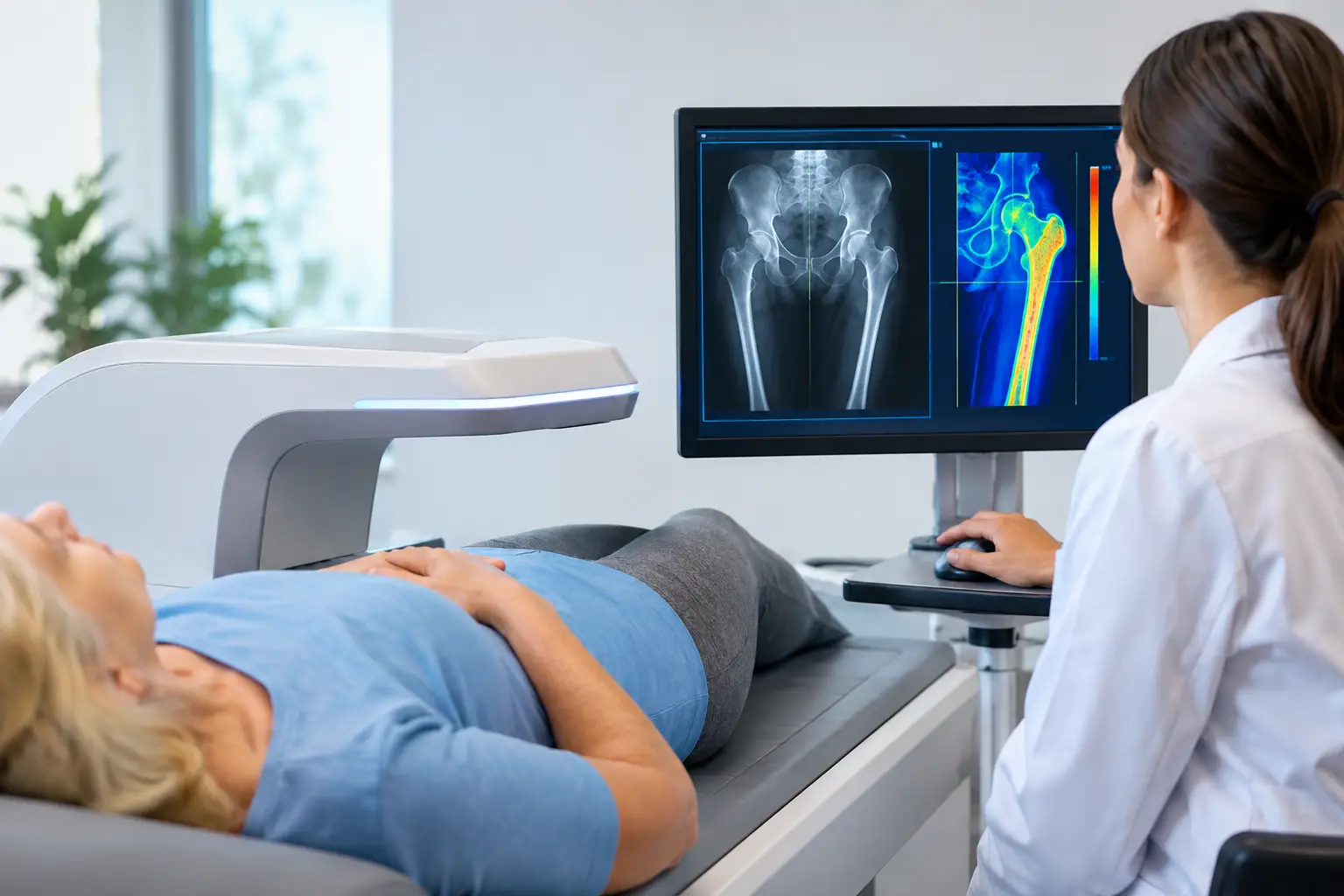
REMS, or Radiofrequency Echographic Multi Spectrometry, uses radiation-free ultrasound to measure bone mineral density at the lumbar spine and proximal femur. It also analyzes the raw ultrasound signals reflected from bone to derive an independent Fragility Score.
The Fragility Score is not another version of the T-score. Density and fragility are related, but they are not interchangeable. Density describes the amount of mineralized bone measured. The Fragility Score reflects signs associated with fragility in the ultrasound signal. REMS then weighs density and the Fragility Score together to estimate five-year fracture risk.
That gives a person facing a bone-related decision three understandable pieces of information:
- bone mineral density at the measured sites
- an independent Fragility Score
- an estimated five-year fracture risk based on both measures
For a surgical consultation, this information can provide useful context rather than a verdict. A surgeon may want to know whether there is established osteoporosis, whether a recent fracture occurred, whether bone-active medications are part of the picture, or whether additional assessment is warranted. A REMS report can help make those conversations more concrete.
It is equally important to be precise about what a REMS scan does not do. It does not assess the exact bone at every surgical site. It does not measure implant stability, predict whether a fusion will heal, determine anesthesia risk, or replace the imaging and clinical evaluation required for surgery. Those are separate questions, answered through the surgeon's assessment and the appropriate diagnostic tools.
The value of a scan is not that it offers certainty where medicine cannot. Its value is that it reduces an avoidable information gap before decisions are made.
Timing can change the usefulness of the information
For some people, the best time to understand their bone status is before a procedure is scheduled. For others, the question arises after a surgeon identifies a concern on imaging, after a low-trauma fracture, or during the planning stage for a joint or spine procedure.
A baseline has value because bone can change during periods that also affect surgical planning or recovery. Menopause can accelerate bone loss. Reduced mobility after injury may change mechanical loading, which is one of the signals that stimulates bone adaptation. Rapid weight loss and some medical treatments can also affect skeletal metabolism. A baseline does not tell you what will happen next, but it creates a meaningful reference point.
REMS precision is particularly relevant when follow-up is part of the clinical conversation. Its intra-operator precision error is below 0.5%, compared with the roughly 0.9% to 1.9% typically reported for DXA at the spine. Low measurement error matters because it improves confidence that a reported change is more likely to reflect a real change in bone rather than ordinary measurement variation.
That does not mean every person needs frequent scanning, and it does not establish a follow-up schedule. Timing depends on the reason for measurement, the clinical context, and the judgment of the treating team. It does mean that when monitoring is appropriate, precision is not a technical footnote. It shapes how confidently changes can be interpreted.
Questions worth bringing to the surgical conversation
If you are preparing for an orthopedic procedure, the goal is not to become your own surgical planner. It is to understand what information would be useful to the clinicians responsible for your care. A few questions can open a productive conversation: Is my known or possible bone loss relevant to this procedure? Does my health history suggest that a bone assessment would add context? If I have a density result, does it tell the whole story of my fracture risk? Would a baseline before surgery be useful for future comparison?
If you already have osteopenia or osteoporosis, it can also help to ask what the result means in the context of your planned procedure rather than treating the diagnosis as a fixed label. A T-score is meaningful, but it is not your entire skeletal story. The same is true if you have never had a bone scan. Absence of prior testing is not evidence that there is a problem, but it does leave a question unanswered.
For people who track cardiovascular markers, glucose, body composition, and fitness data, this can be an overlooked part of preoperative preparation. Most adults know far more about their cholesterol than about the current state of their bones. Yet bone loss and fragility can remain silent until a fracture or an imaging finding forces the issue.
Information before consequences
Surgery is often a moment when scattered health information finally comes together. A bone assessment cannot replace surgical expertise, nor should it be used to create fear around a procedure. But it can help you move from a vague concern about “bone quality” to specific measurements that can be discussed with your care team.
MobileREMS provides density, an independent Fragility Score, and estimated five-year fracture risk in a radiation-free assessment. For someone considering surgery, the most useful result may be a clearer question for their clinician: given what we now know about my bones, does anything need further attention before or after this procedure?
That is the practical purpose of bone surgery readiness: not to predict every outcome, but to make the invisible part of skeletal health understandable before consequences make the conversation unavoidable.