
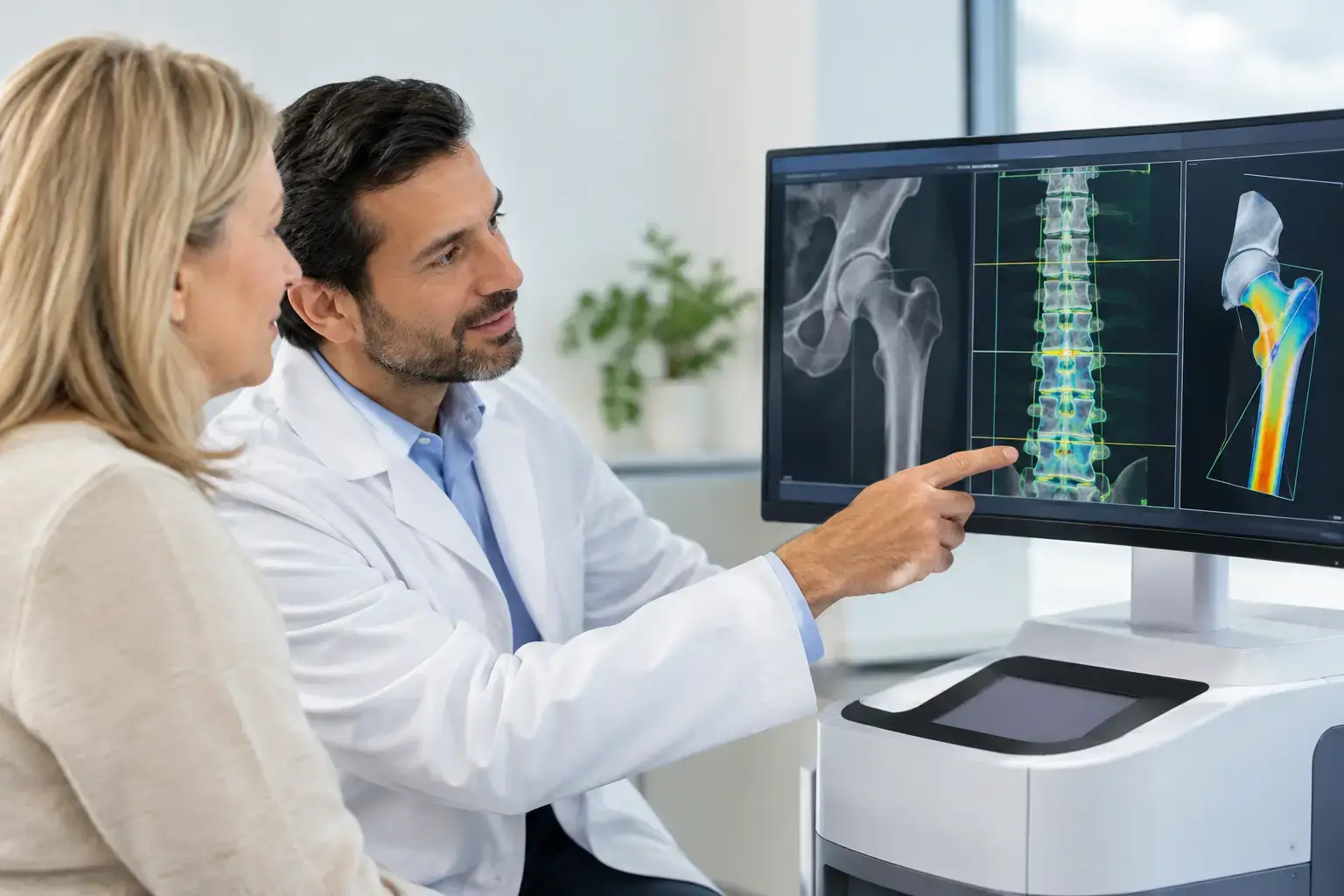
A good REMS clinic partnership example begins with a familiar clinical gap: a patient wants to understand fracture risk, but the available conversation centers on one density number. That number matters. It does not always explain why two people with similar bone mineral density can face meaningfully different levels of skeletal fragility.
For a practice, the opportunity is not simply to add another test. It is to give patients more useful bone information at the point when they are making decisions about menopause, osteopenia, type 2 diabetes, medication, rapid weight loss, or orthopedic care. A well-designed partnership keeps the roles clear: the REMS provider performs the measurement and delivers the report; the patient’s clinical team interprets that information in the context of the full medical picture.
What a REMS clinic partnership can add
REMS, or radiofrequency echographic multi-spectrometry, uses ultrasound rather than ionizing radiation to measure bone mineral density at the lumbar spine and proximal femur. It also analyzes the raw ultrasound signals reflected from bone to derive an independent Fragility Score.
That distinction is the reason a partnership may be useful. Density tells you how much mineralized bone is present. The Fragility Score reflects signs associated with greater skeletal fragility that density alone does not capture. REMS then weighs density and Fragility Score together to estimate fracture risk over the next five years.
Consider two patients whose density results both fall in a similar range. One may have a lower Fragility Score and a lower estimated fracture risk. The other may show a higher Fragility Score, changing the clinical conversation from “the density is similar” to “the overall information about fragility is not.” Neither result replaces judgment, medical history, or other assessments. But the difference may give the patient and clinician a more complete starting point.
This is particularly relevant when density can look more reassuring than fracture risk. Type 2 diabetes is the clearest example. People with type 2 diabetes may have normal or even higher bone mineral density while still experiencing elevated fracture risk. The biology is complex and may include changes in bone material properties related to chronic hyperglycemia, along with fall-related risks and other factors. A density result alone can miss part of that story.
A practical REMS clinic partnership example
Imagine a concierge medicine, naturopathic, nurse practitioner, or functional-medicine practice that sees many patients in perimenopause and menopause. The practice already discusses cardiometabolic health, strength, nutrition, hormone-related changes, and preventive screening. Yet many patients reach this transition without a meaningful baseline for their bones.
The clinic schedules a dedicated bone-health assessment day with a mobile REMS provider. Eligible patients book through the practice or through the provider’s scheduling process, depending on the arrangement. At the visit, the REMS operator obtains lumbar spine and proximal femur measurements using radiation-free ultrasound. The patient leaves with a report showing bone mineral density, Fragility Score, and estimated five-year fracture risk.
The report is then available for the patient to bring back to the referring clinician. The clinician can place the results alongside menstrual history, medications, family history, metabolic health, prior fractures, laboratory findings, body-weight changes, and any other relevant information. That is where the clinical value becomes practical: not in treating a report as a verdict, but in making an otherwise invisible part of health visible enough to discuss.
For a patient whose density is lower than expected, the report provides an objective baseline that can be followed. For a patient whose density appears acceptable but whose Fragility Score suggests greater concern, it may prompt a more careful conversation rather than false reassurance. For a patient with favorable findings, it establishes a reference point before a future change in health status or life stage.
The workflow should protect clinical clarity
The strongest partnerships avoid blurred responsibility. A REMS service should be explicit about what it provides: the measurement, the standardized report, and clear explanation of what each reported value represents. The partnering clinic remains responsible for medical assessment, diagnosis, treatment decisions, and follow-up within its scope of practice.
This separation is not administrative fussiness. Bone health is shaped by many factors that a scan cannot independently resolve. A history of low-trauma fracture, glucocorticoid exposure, cancer treatment, kidney disease, endocrine conditions, nutritional status, mobility, and fall risk can all matter. The scan adds information. It does not erase the need for clinical context.
Patients benefit when they hear this in plain language. A report can answer, “How much mineralized bone do I have?” “Is the ultrasound signal showing signs associated with greater fragility?” and “What does the combination suggest about five-year fracture risk?” It cannot, by itself, tell a patient why a finding occurred or dictate what should happen next.
Why follow-up timing matters
REMS is FDA-cleared and radiation-free, which makes repeat measurement practical when there is a clinical reason to monitor change. Its reported intra-operator precision error is below 0.5%, compared with the 0.9% to 1.9% commonly reported for DXA at the spine.
Precision is not a technical detail reserved for equipment specifications. It determines how confidently a measured change can be distinguished from measurement noise. If a method varies too much from one scan to the next, a small shift may say more about the instrument than about the patient’s bones.
For a partnership, this can support a more responsive monitoring conversation. It does not mean every patient needs frequent scans, and it does not establish a universal retesting interval. Timing depends on the individual’s situation and the question the clinician is trying to answer. But when bone change is relevant - during significant weight loss, after a treatment decision, or through a period of elevated risk - a precise, radiation-free method offers a useful way to observe rather than guess.
A partnership model is not one-size-fits-all
An established primary-care practice may want a periodic on-site assessment day for patients who meet defined criteria. A menopause-focused clinic may frame REMS as part of an earlier baseline conversation, before standard age-based screening would typically occur. An orthopedic or surgical practice may use objective bone information to inform a broader pre-procedure discussion.
The trade-off is operational. On-site days can make access easier and create a focused educational moment, but they require scheduling coordination and enough patient interest to use the time well. A referral-based model is simpler for the clinic, though the patient has an additional appointment to arrange. Neither is inherently better. The appropriate model depends on patient volume, geography, workflow, and how closely the practice wants bone assessment integrated into ongoing care.
For clinics in the Seattle area and across Washington, MobileREMS can bring the technology to a practice setting rather than requiring every patient to seek out a fixed imaging location. That convenience matters most when it supports a sound clinical process, not when it becomes the entire reason for testing.
What patients should understand before a partnership visit
A clinic partnership works best when patients know they are receiving more than a screening number, but not a substitute for comprehensive care. The purpose is information before consequences: an earlier view of density, fragility-related signal findings, and estimated fracture risk that can be discussed with a trusted clinician.
That framing is especially helpful for people who have been told they have osteopenia or osteoporosis. A T-score remains meaningful, but it is not the whole question. Many people reasonably want to know whether the structural signals associated with fragility tell the same story as density, and whether future measurements show a change worth taking seriously.
The same applies to prevention-minded adults who already track blood pressure, glucose, body composition, and fitness. Peak bone mass is largely built by the late twenties, genetics influences the ceiling, and bone loss can begin long before anyone feels it. Bones deserve the same practical attention as other measurable parts of health, without turning normal uncertainty into alarm.
A thoughtful REMS partnership does not promise certainty. It gives you a clearer question to take into care: not only how much bone is present, but what the available information suggests about fragility and fracture risk. That is a more useful place to begin than waiting for a consequence to make the conversation unavoidable.